Puppy Teething Timeline
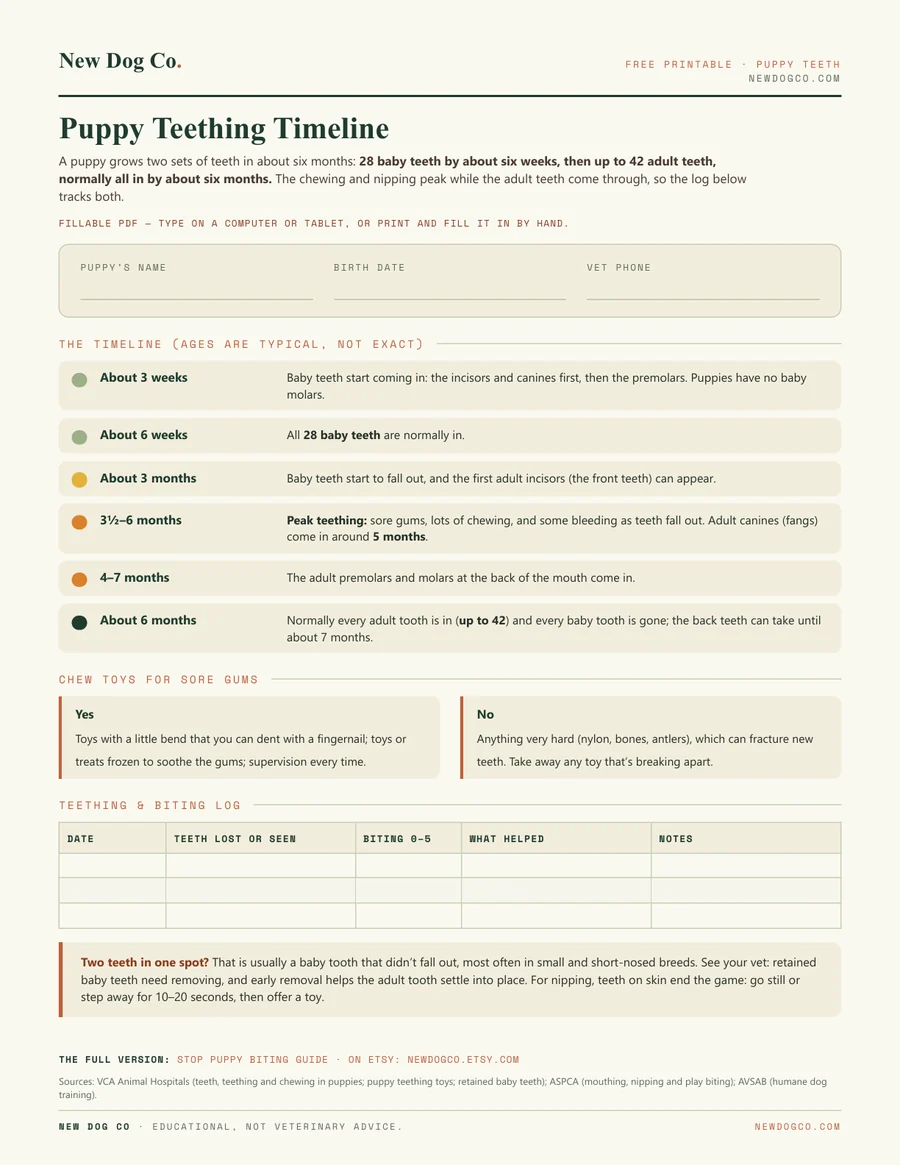
When do puppies teethe? Baby teeth start coming in at about three weeks, and all 28 are normally in by about six weeks. They start to fall out at around three months, the hardest teething runs from about three and a half to six months, and normally every adult tooth is in (up to 42) by about six months, according to VCA Animal Hospitals. This one-page timeline shows each stage, which chew toys are safe for sore gums, what a retained baby tooth looks like, and gives you a log to track teeth and nipping together.
Fillable · bilingual EN/ES · vet-sourced, not a scanned template.
 Got the free sheet? The full version → Stop Puppy Biting Guide
What's inside
- The timeline from the first baby teeth at about 3 weeks to a full adult set at about 6 months
- When each adult tooth type arrives: incisors, canines, premolars and molars
- Chew toys for sore gums: the fingernail test, frozen toys, and what to avoid
- A fillable teething and biting log: date, teeth lost or seen, biting score, what helped
- What a retained baby tooth looks like, and why to see your vet early
How to use it
- Write in your puppy’s birth date and count forward to see which stage you are in.
- Check your puppy’s mouth now and then for teeth that are loose, lost, or doubled up.
- Log teeth and nipping on the same line, so you can see the biting ease as the adult teeth come in.
- Take the sheet to your vet if a baby tooth is still in place beside its adult tooth.
Sources
Vet-sourced: the facts on this sheet come from these sources. It is educational, not veterinary advice.
- VCA Animal Hospitals (teeth, teething and chewing in puppies; puppy teething toys; retained baby teeth)
- ASPCA (mouthing, nipping and play biting)
- AVSAB (humane dog training)
Published
New printables + calm, sourced dog-care tips
Join the Pack and the 25-printable bundle is your instant thank-you — then we email new printables and short, vet-sourced tips as they’re ready. A few times a month, no spam.
The 25-printable pack lands instantly — new printables and tips follow. Unsubscribe anytime. Privacy Policy.Frequently asked questions
- When do puppies stop teething?
- For most puppies, around six months. VCA says teething begins at about three and a half to four months, as the baby incisors are replaced, and lasts until about six months, when normally every adult tooth is in and every baby tooth has fallen out. The back teeth can take until about seven months.
- How many teeth does a puppy have?
- A puppy has 28 baby teeth, and an adult dog has up to 42 permanent teeth. Puppies have no baby molars, so the molars at the back come in only with the adult set.
- Is it normal for a teething puppy’s gums to bleed?
- A little, yes. VCA notes that some bleeding can happen when the baby teeth are falling out. Teething should be uncomfortable, not agonizing: if your puppy seems in real pain or the bleeding is more than a little, call your vet.
- What can I give a teething puppy to chew?
- Toys with a little bend that you can dent with a fingernail, and toys or treats frozen to soothe sore gums. VCA advises against anything very hard, such as nylon, bones or antlers, which can fracture the new teeth. Supervise every chew session and throw away any toy that is breaking apart.
- What if a baby tooth doesn’t fall out?
- Look for what looks like two teeth in the same spot. That is a retained baby tooth, which is more common in small and short-nosed breeds. VCA says retained baby teeth need removing, and that removing one early can let the adult tooth move into its proper position, so book a vet visit.
- Does teething make puppies bite more?
- It adds to it. Most puppies mouth hardest through the teething months and ease off once the adult teeth are in, often around five to six months. Redirect nipping onto a toy and end the game when teeth touch skin; never punish it.
Free educational printable. Not veterinary advice, and not a substitute for your vet's official records or an emergency call. Full disclaimer → · Leer en español →