When do puppy vaccinations start and finish?
Puppy shots start early and arrive in rounds. The first core dose usually goes in at 6 to 8 weeks of age, and the series finishes when the last round is given at 16 weeks of age or older, following the American Animal Hospital Association (AAHA). Most puppies have three or four visits, spaced two to four weeks apart, across that stretch.
It is a series rather than a single shot because of the immunity a puppy gets from its mother. A nursing puppy carries antibodies from mom that fade at an age no one can predict. While those antibodies are still high, they can block a vaccine from taking hold. Repeating the dose every few weeks makes sure at least one lands after the mother's protection wears off — and before the puppy meets the disease on its own.
Missing or stretching a round can leave a gap in that plan, so the dates matter. Writing each visit down as it happens is the easiest way to stay on track.
What does each puppy round protect against?
The backbone of the series is DHPP, sometimes printed as DAP or DA2PP. It is one combined shot that covers four diseases: distemper, hepatitis (adenovirus), parainfluenza, and parvovirus. Parvovirus alone is a leading killer of unvaccinated puppies, which is why this combination is given first and repeated.
Leptospirosis is added partway through the series. AAHA moved it into the core group in 2024 because almost any dog that spends time outdoors can be exposed, and the disease can pass to people.
Rabies is the third core piece and is required by law across most of the United States. It is usually given once the puppy is around 12 to 16 weeks old, with the exact timing set by your state.
What does the puppy vaccine schedule look like week by week?
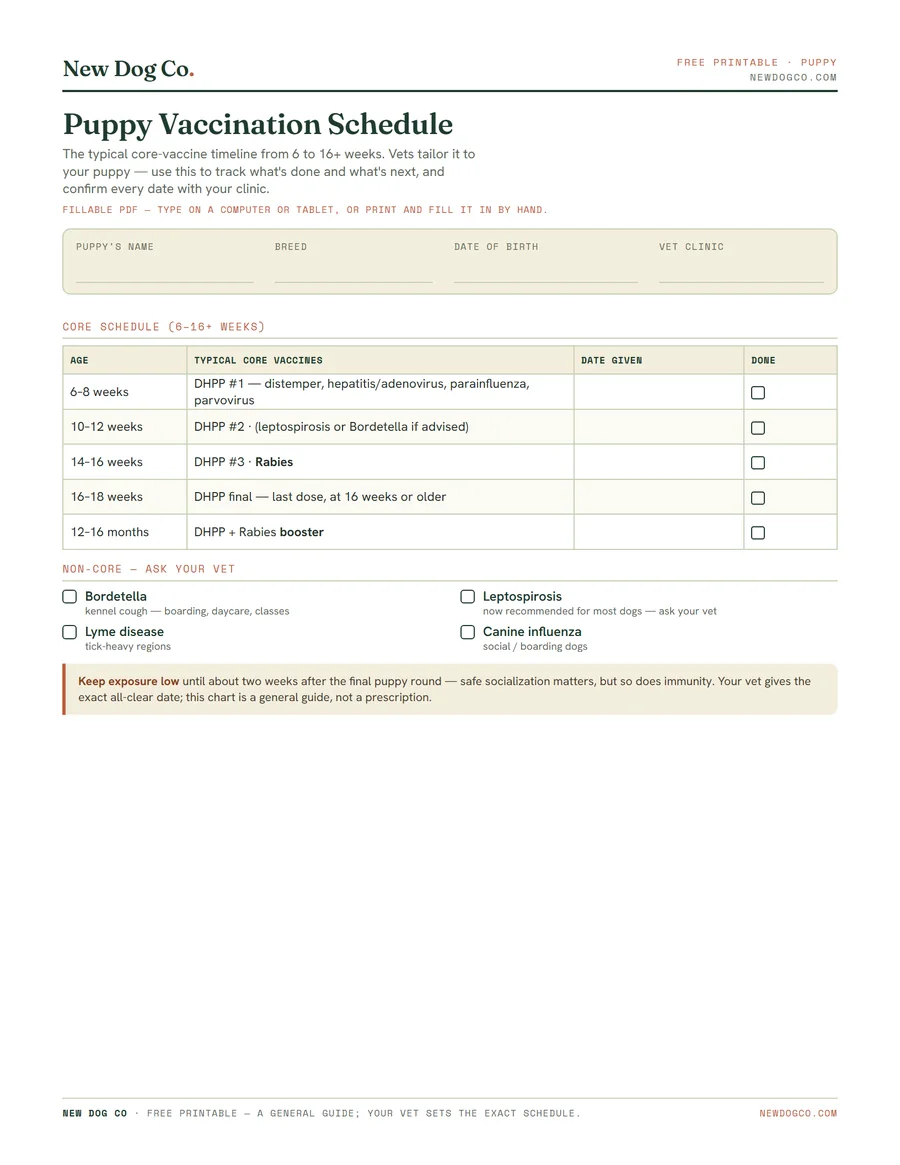
Here is a general, age-based guide to the core puppy series, built from AAHA's recommendations. Your veterinarian sets the real dates for your puppy — some clinics shift a visit by a week or two — so use this as a map rather than a fixed rule.
| Age | Core vaccines due | Notes |
|---|---|---|
| 6–8 weeks | DHPP #1 | First puppy visit; leptospirosis and rabies are not given yet. |
| 10–12 weeks | DHPP #2 | Second round, 2–4 weeks after the first. |
| 14–16 weeks | DHPP #3, leptospirosis (dose 1), rabies | Leptospirosis is never given before 12 weeks; rabies timing is set by state law. |
| 16–18 weeks | DHPP final dose (given at 16 weeks or older), leptospirosis (dose 2) | Leptospirosis dose 2 falls 2–4 weeks after dose 1. |
| 12–16 months | DHPP booster, rabies booster, leptospirosis booster | First adult boosters, about a year after the puppy series. |
| Every year after that | Leptospirosis every year; DHPP and rabies on a longer schedule | AAHA often spaces adult DHPP every three years; rabies follows your state law. |
Notice that the puppy series does not end at the last shot. The boosters around 12 to 16 months lock in the protection the puppy series started, and they are just as important as the early rounds.
How does leptospirosis fit into the puppy series?
Leptospirosis has its own timing rules, and they are worth getting right. It is given as two doses. The first cannot be given before 12 weeks of age, and the second follows two to four weeks after the first. That is why lepto appears later in the schedule than the first DHPP shots.
After the puppy series, leptospirosis needs a booster every single year to keep working — it does not stretch to the multi-year gaps some other vaccines can. Because it is easy to forget a yearly shot, this is the one owners most often let slip, and a written next-due date is the simplest guard against that.
Which puppy shots are core, and which are optional?
Core vaccines are the ones nearly every puppy should get: DHPP, rabies, and leptospirosis, per AAHA. Those make up the schedule above.
Non-core, or lifestyle, vaccines are matched to your puppy's life. The common ones are Bordetella (kennel cough), often required before puppy classes, boarding, or daycare; Lyme, in tick-heavy regions; and canine influenza, where outbreaks occur or before group settings. None of these are automatic — your veterinarian weighs where you live and what your puppy will do, then recommends what fits.
When can my puppy meet other dogs and go outside?
This is the question new owners worry about most, and the answer is to socialize carefully, not to wait it out. The American Veterinary Society of Animal Behavior (AVSAB) stresses that a puppy's most important learning window is roughly its first three months, and that behavior problems — not infections — are the most common behavioral reason young dogs lose their homes.
The safe path is controlled exposure. Until about two weeks after the final puppy round, keep your puppy off ground where unknown or unvaccinated dogs go — dog parks, pet-store floors, highway rest stops — and away from dogs whose vaccine status you do not know. In that same window, keep socializing in safe ways: healthy vaccinated dogs you already know, calm visitors, car rides, and the new sounds, surfaces, and handling your puppy meets at home.
A well-run puppy class fits here too. AVSAB suggests a puppy have at least one set of vaccines about a week before the first class, which is exactly what your schedule sheet shows the staff.
What should I bring to each puppy vet visit?
A little preparation makes each visit faster and more useful. Bring your vaccination record or this schedule so the team can see what has been given and what is next. Bring any paperwork from the breeder, shelter, or previous owner, since a puppy may already have had its first shot before you brought it home.
Come with your questions written down — lifestyle vaccines, spay or neuter timing, parasite prevention, food — and a few treats to keep the visit positive, which the ASPCA notes helps a puppy feel safe at the clinic. Before you leave, confirm the date of the next round and write it on your record while you are still at the desk.