
The core vaccine series, and why the boosters are the point
Puppies do not get one shot and finish. According to the AAHA Canine Vaccination Guidelines, the core series (DAP, which covers distemper, adenovirus, and parvovirus) starts around 6 to 8 weeks of age and repeats every 2 to 4 weeks until the puppy is at least 16 weeks old. Rabies is given once at 12 weeks or older, following your local law.
The repeats are not padding. A puppy is born with maternal antibodies from its mother's milk that protect it early but also block vaccines from working. Those antibodies fade at different ages in different puppies, and there is no cheap way to know the exact day for yours. Giving the series every few weeks makes sure at least one dose lands after the maternal antibodies have dropped low enough for the vaccine to take. That is why a puppy that stops the series at 12 weeks can still be unprotected against parvovirus, a common and often fatal disease. AAHA also calls for a booster of the core vaccine at either 6 months or one year to close any remaining gap.
The planning takeaway: write down the date of every visit and, in the same row, the date the next one is due. A missed 4-week window is the most common way protection slips through the cracks.
The socialization window is short, and it does not wait for the last shot
The single most useful thing you can plan is socialization, and its timing is fixed by biology. The AVSAB (American Veterinary Society of Animal Behavior) position statement identifies roughly 3 to 14 weeks of age as the sensitive period when puppies most readily accept new people, animals, sounds, surfaces, and handling as normal. Experiences a puppy misses in that window are much harder to make up later.
This creates a real tension, because the vaccine series is not complete until 16 weeks. AVSAB is direct about it: the behavioral problems that come from under-socialization are the number one cause of death for dogs under three years old, through relinquishment and euthanasia, and that risk is greater than the disease risk of careful early socialization. Their guidance is that puppies can begin socialization classes as early as 7 to 8 weeks, as long as they have had at least one set of vaccines about 7 days beforehand and a first deworming.
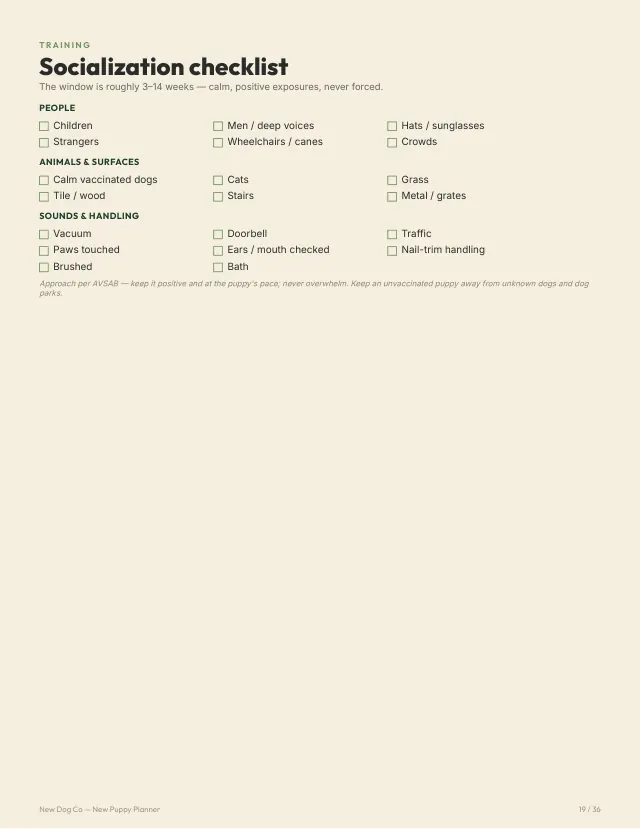
A safe plan while the series is still in progress: invite calm, vaccinated adult dogs to your home; carry your puppy through busy places; let it meet many different people; expose it to sounds, car rides, and surfaces. Avoid dog parks, pet-store floors, and other high-traffic ground where parvovirus can linger. Keep every exposure short and positive, using treats and praise, and let the puppy retreat if it wants to. A milestone page where you check off exposures keeps you honest about variety instead of repeating the same three friends.
Feeding by age, and why the amount keeps changing
Puppies eat more often than adult dogs because their stomachs are small and their growth is fast. A common rhythm, in line with ASPCA guidance, is roughly four meals a day up to about 3 months, three meals a day from about 3 to 6 months, and two meals a day after that, which most dogs keep for life. Free-feeding, leaving food out all day, makes house-training harder and hides appetite changes that can be an early sign of illness.
Feed a food labeled complete and balanced for growth by AAFCO standards; that label is the real signal, not the price. If you have a large or giant breed, choose a large-breed puppy formula, because controlling the growth rate lowers the risk of orthopedic problems later. Follow the amount on the package for your puppy's weight and expected adult size, then adjust with your vet, since packages tend to overstate portions.
Logging the food type and amount matters for one practical reason: the right portion at 10 weeks is wrong at 16 weeks. A feeding log shows the trend, makes it obvious when it is time to drop a meal, and gives your vet real numbers instead of a guess at the next checkup.
House-training and the crate: rhythm, not punishment
House-training runs on predictable timing. A useful rule of thumb is that a puppy can hold its bladder for about one hour per month of age, plus one, so a two-month-old puppy needs a trip outside roughly every three hours, including overnight at first. Take the puppy out after every wake-up, meal, drink, and play session, and reward the moment it finishes in the right place. Reward-based training is what the AVSAB supports; punishing accidents teaches a puppy to hide, not to hold.
A crate helps because dogs avoid soiling where they sleep, but only if it is a calm place and never a punishment. Size it so the puppy can stand, turn, and lie down, and no larger, or it will use one end as a bathroom. Build up crate time slowly with treats and short absences. Accidents will happen; clean them with an enzymatic cleaner so no scent cue remains, and note the pattern rather than scolding. A potty log that records times and results usually reveals a schedule within a week, which is what actually ends the accidents.
Why writing it down beats trusting memory
The first months are short on sleep and full of dates, and the details that matter are exactly the ones easy to lose. Which vaccine was given last, and what is due next. The microchip number and the registration login. The emergency clinic's address at 2 a.m. The weight last month, so you can see whether growth is on track. The name of the food, in case you need to match it or report a reaction.
A planner is not busywork; it is the difference between a smooth checkup and a scramble. When everything lives in one fillable place, anyone caring for the puppy can see the same schedule, your vet gets accurate history instead of guesses, and nothing slips because it was only ever in one tired person's head. Fill the vet and emergency contacts on day one, log each visit as it happens, and keep the feeding and potty pages current. That habit, more than any single product, is what carries a puppy safely through its first months.