Dog Body Language Chart
Most dog “misbehavior” is really missed signals. This one-page chart decodes the whole dog — ears, eyes, mouth, tail, and posture — so you can read the cluster instead of guessing from a single wag. It maps the calming signals (lip licks, yawns, looking away) and the clear warnings (hard stare, whale eye, freeze, stiff tail) that mean stop and give space. Pin it where the whole family passes, and everyone starts reading your dog the same way. Force-free, and sourced from AVSAB, ASPCA, and AVMA.
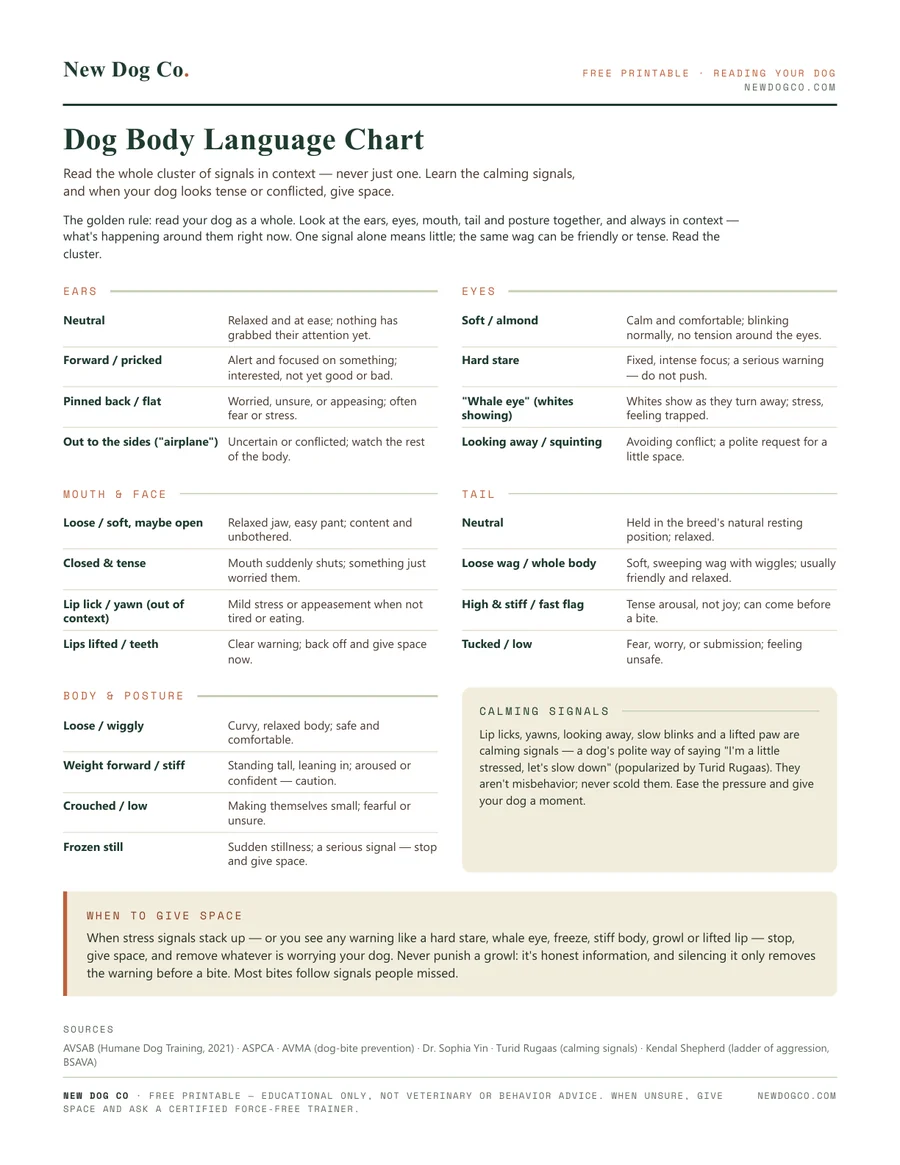
Print-ready reference · bilingual EN/ES · vet-sourced — not a scanned template.
 Got the free sheet? The full version → Dog Body Language Chart Pack $3.73
 What's inside
- Five signal groups decoded — ears, eyes, mouth & face, tail, and body & posture — with four reads each
- A calming-signals box: what lip licks, yawns, and looking away really mean
- A “when to give space” rule for the warnings that come before a bite
- The golden rule: read the whole cluster in context, never a single signal
- Sources on the page (AVSAB, ASPCA, AVMA, Yin, Rugaas, Shepherd) — and both US Letter and A4
How to use it
- Download and print it (or open the PDF on a phone or tablet).
- Pin it somewhere everyone passes — the fridge, the crate wall, the leash hook.
- When your dog does something, find the signal group and read the whole body together.
- At the first warning — hard stare, whale eye, freeze, stiff tail — give space and ease the pressure.
New printables + calm, sourced dog-care tips
Join the Pack and the 25-printable bundle is your instant thank-you — then we email new printables and short, vet-sourced tips as they’re ready. A few times a month, no spam.
The 25-printable pack lands instantly — new printables and tips follow. Unsubscribe anytime. Privacy Policy.Frequently asked questions
- Is this dog body language chart really free?
- Yes — the PDF downloads with no email and no payment, in US Letter and A4. There is an optional email offer below the download, but the chart itself is completely free to print, pin, and share.
- Can I trust the information on it?
- The chart follows force-free, science-based sources: the American Veterinary Society of Animal Behavior (AVSAB), the ASPCA, the AVMA, and the work of Dr. Sophia Yin, Turid Rugaas, and Kendal Shepherd. It is educational, not a substitute for a certified trainer or your vet.
- Why does it say to read the “whole cluster”?
- Because one signal alone means little — the same tail wag can be friendly or tense. Reading the ears, eyes, mouth, tail, and posture together, in the moment and in context, is the only reliable way to know how your dog actually feels.
- Should I punish growling or warning signs?
- No. A growl is honest information; punishing it only removes the warning and makes a bite more likely, not less. The chart shows you how to spot the earlier, quieter signals so you can add space long before a dog feels forced to growl.
- Is it good for kids and the whole family?
- Yes — that is exactly why it is one page. Pin it where everyone sees it so kids and adults learn the same signals, especially the “give space now” warnings, and everyone reads the dog consistently.
Free educational printable. Not veterinary advice, and not a substitute for your vet's official records or an emergency call. Full disclaimer → · Leer en español →