Dog Dementia Signs Checklist
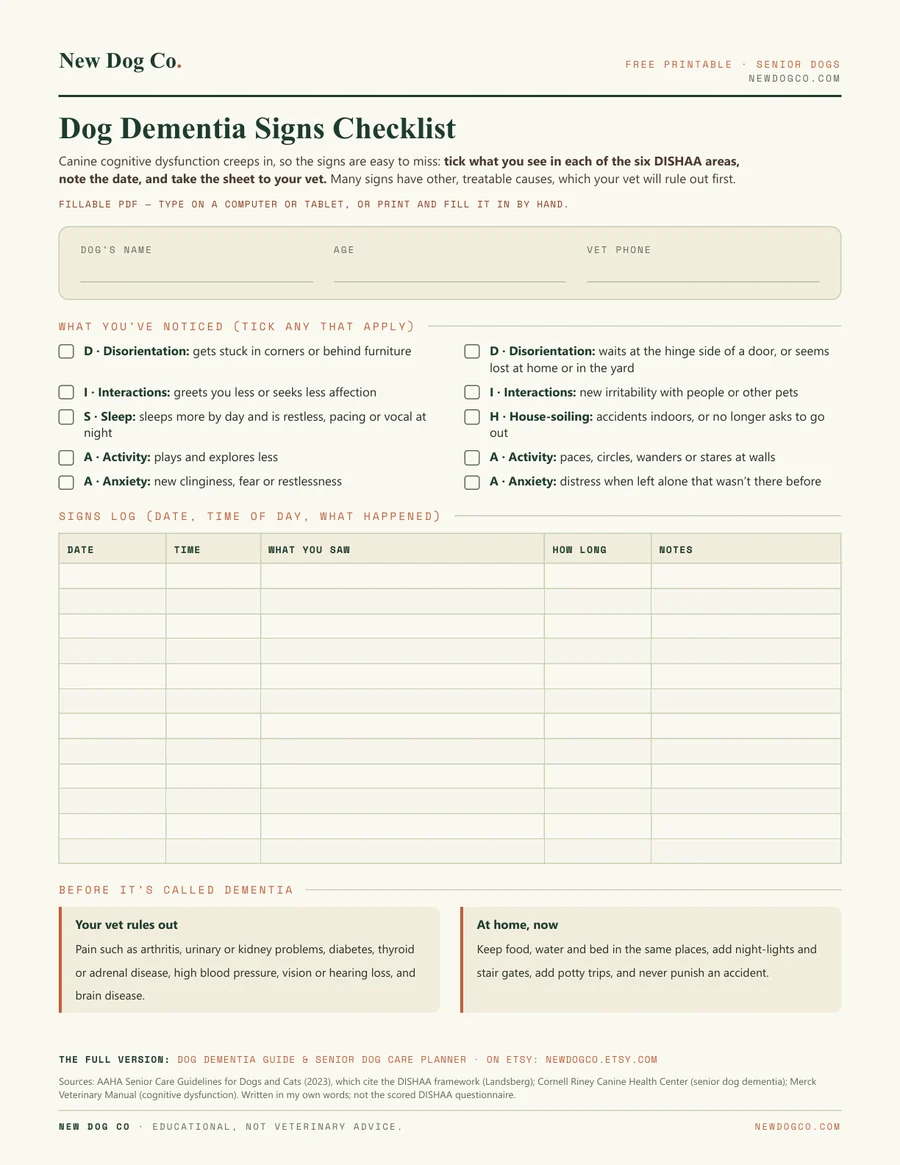
What are the signs of dementia in dogs? Veterinarians group them into six areas, known as DISHAA: disorientation, changes in interactions, sleep-wake changes, house-soiling, activity changes and anxiety. This one-page checklist lists the everyday signs in each area, in my own words, so you can tick what you see, log when it happens, and bring a dated record to your vet. It also lists the treatable conditions your vet will rule out first, because canine cognitive dysfunction is diagnosed by exclusion.
Fillable · bilingual EN/ES · vet-sourced, not a scanned template.
 Got the free sheet? The full version → Dog Dementia Guide & Senior Dog Care Planner
What's inside
- Ten everyday signs, grouped by the six DISHAA areas, to tick off
- A fillable signs log: date, time of day, what you saw, how long, notes
- The conditions your vet will rule out before calling it dementia
- Four home changes that help right away
How to use it
- Tick any sign you have noticed in the last few weeks.
- For two weeks, log each episode with the date and time of day, especially at night.
- Bring the sheet to your vet, so the pattern is on paper and not just a feeling.
- Start the home changes now; they help whatever the diagnosis turns out to be.
Sources
Vet-sourced: the facts on this sheet come from these sources. It is educational, not veterinary advice.
- AAHA Senior Care Guidelines for Dogs and Cats (2023), which cite the DISHAA framework (Landsberg)
- Cornell Riney Canine Health Center (senior dog dementia)
- Merck Veterinary Manual (cognitive dysfunction)
Written in my own words; not the scored DISHAA questionnaire.
Published
New printables + calm, sourced dog-care tips
Join the Pack and the 25-printable bundle is your instant thank-you — then we email new printables and short, vet-sourced tips as they’re ready. A few times a month, no spam.
The 25-printable pack lands instantly — new printables and tips follow. Unsubscribe anytime. Privacy Policy.Frequently asked questions
- What are the signs of dementia in dogs?
- Vets group them into six areas, known as DISHAA: disorientation (getting stuck or seeming lost), changes in interactions, sleep-wake changes, house-soiling, activity changes such as pacing or staring, and new anxiety. The framework comes from veterinary behaviorist Dr. Gary Landsberg and is cited in the AAHA 2023 senior care guidelines.
- What is often the first sign?
- Changes in sleep, according to Cornell’s Riney Canine Health Center: sleeping more during the day and being restless, pacing or vocal at night.
- How common is dementia in old dogs?
- More common than most people expect. A widely cited study found about 28% of dogs aged 11 to 12 showed at least one sign of cognitive decline, rising to about 68% at 15 to 16. Another estimated that about 14% of older dogs had the condition, but only about 2% had been diagnosed.
- How do vets diagnose it?
- By ruling other things out. There is no single test in a living dog, so your vet looks for the DISHAA pattern and checks for pain, urinary or kidney problems, diabetes, thyroid or adrenal disease, high blood pressure, vision or hearing loss and brain disease, with an exam plus blood and urine tests.
- Is this the DISHAA questionnaire?
- No. It groups the signs by the DISHAA areas, in my own words, to help you notice and record them. Your vet may use a scored questionnaire such as DISHAA or the CADES scale to measure severity and track changes.
- Can dog dementia be treated?
- It can’t be cured, but it can often be slowed. A predictable routine, gentle mental enrichment, a safer home, and sometimes a therapeutic diet, supplements or medication help, ideally combined and started early. Selegiline is the only drug FDA-approved for canine cognitive dysfunction; your vet decides whether it suits your dog.
Free educational printable. Not veterinary advice, and not a substitute for your vet's official records or an emergency call. Full disclaimer → · Leer en español →