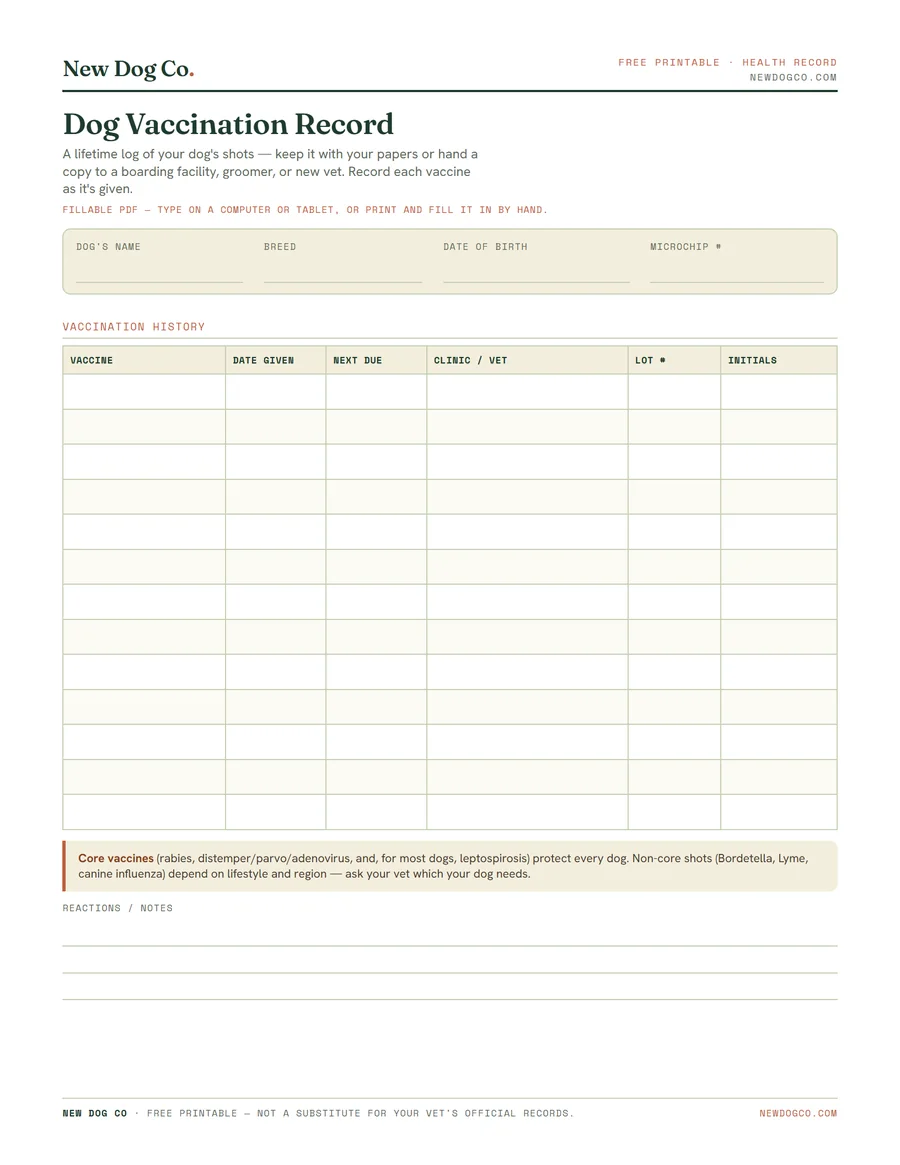
What is a dog vaccination record, and why keep one?
A dog vaccination record is a simple running list of every shot your dog has had — the vaccine name, the date it was given, and when the next one is due. Think of it as your dog's health passport: one page you can hand to anyone who needs proof.
You will reach for it more often than you would expect. Boarding kennels, daycares, groomers, dog-walkers, trainers, and puppy classes almost always ask to see proof of current vaccines before they will take your dog. A new vet, or an emergency clinic on a weekend, will want the history too, so they do not repeat a shot or miss one.
Keeping your own copy also protects you if you move, switch clinics, or lose touch with the practice that first vaccinated your dog. Records get lost; a printout in your dog's folder does not.
What is the difference between core and non-core vaccines?
Veterinary groups sort dog vaccines into two buckets. Core vaccines are the ones nearly every dog should have, because the diseases they prevent are widespread, serious, or dangerous to people. Non-core (also called lifestyle) vaccines are recommended based on where your dog lives, travels, and spends time.
According to the American Animal Hospital Association (AAHA), the core vaccines for dogs are DHPP/DAP (distemper, adenovirus/hepatitis, parainfluenza, and parvovirus), rabies, and — as of AAHA's 2024 update — leptospirosis. Leptospirosis moved into the core group because almost any dog that goes outdoors can be exposed.
Non-core vaccines include Bordetella (kennel cough), Lyme, and canine influenza. These are not lesser vaccines; they are simply matched to risk. Your veterinarian is the right person to decide which lifestyle vaccines your dog needs.
Rabies sits in a category of its own as well: it is a core vaccine and it is required by law in most of the United States. The exact timing and how often boosters are due are set by your state, which is one more reason to keep the dates written down.
What does the core vaccine schedule look like by age?
The table below is a general, age-based guide to the core series, built from AAHA's recommendations. Your veterinarian always sets the real dates for your individual dog, so treat this as a map rather than a prescription.
| Age | Core vaccines due | Notes |
|---|---|---|
| 6–8 weeks | DHPP #1 | First puppy visit; leptospirosis and rabies are not given yet. |
| 10–12 weeks | DHPP #2 | Second round, 2–4 weeks after the first. |
| 14–16 weeks | DHPP #3, leptospirosis (dose 1), rabies | Leptospirosis is never given before 12 weeks; rabies timing is set by state law. |
| 16–18 weeks | DHPP final dose (given at 16 weeks or older), leptospirosis (dose 2) | Leptospirosis dose 2 falls 2–4 weeks after dose 1. |
| 12–16 months | DHPP booster, rabies booster, leptospirosis booster | First adult boosters, about a year after the puppy series. |
| Every year after that | Leptospirosis every year; DHPP and rabies on a longer schedule | AAHA often spaces adult DHPP every three years; rabies follows your state law. |
A few things are worth noticing. Puppies get distemper and parvo (DHPP) as a series, not a single shot, because a puppy's immunity from its mother fades at an unpredictable time and can block an early dose. Repeating the shot every few weeks makes sure at least one lands after that protection wears off. AAHA recommends that the final puppy DHPP be given at 16 weeks of age or older.
How does the leptospirosis vaccine work?
Leptospirosis is a bacterial disease dogs pick up from water, soil, or wildlife urine, and it can spread to people, which is part of why AAHA now treats it as core.
The vaccine is given as a two-dose puppy series. The first dose is given no earlier than 12 weeks of age, and the second follows two to four weeks later. After that, leptospirosis needs a booster every year to stay protective — it is the one core vaccine that does not stretch to a multi-year interval.
Because of that yearly rhythm, leptospirosis is the vaccine owners most often let lapse by accident. A written record with the next-due date is the simplest way to catch it in time.
When can my puppy meet other dogs and go out in public?
This is where a good record and good timing work together. The American Veterinary Society of Animal Behavior (AVSAB) is clear that early socialization matters enormously: a puppy's most important window for meeting the world is roughly its first three months, and behavior problems, not infections, are the leading behavioral reason young dogs lose their homes.
The balance is to socialize safely rather than not at all. Until about two weeks after the final puppy round, keep your puppy away from unknown dogs and from ground where unvaccinated dogs may have been — dog parks, pet-store floors, highway rest stops. In that same window, controlled exposure is still encouraged: calm friends, healthy vaccinated dogs you already know, a well-run puppy class, car rides, and new sounds and surfaces at home.
AVSAB suggests a puppy have at least one set of vaccines about a week before starting a puppy class. Your record is how the class confirms it.
Is this the same as my vet's official record?
Not quite, and it helps to know the difference. Your veterinarian keeps the official medical record, and the clinic can issue certificates — a rabies certificate especially — that carry legal and licensing weight. That is the version an authority or a border crossing may require.
Your at-home printout is your working copy: quick to grab, easy to update, and good enough for a groomer or a boarding front desk that simply wants to see current dates. When something official is required, ask your clinic for the certificate. Keep both, and your dog is covered in every situation.
How do I use the record over my dog's whole life?
Start it at the first puppy visit and never stop. Write in each vaccine, the date, and the next-due date the moment you leave the clinic, while the paperwork is still in your hand.
After the puppy series and the boosters around 12 to 16 months, most adult dogs settle into a rhythm: leptospirosis every year, and DHPP and rabies on a longer schedule — often every three years for DHPP under AAHA guidance, with rabies following your state's law. The ASPCA and AVMA both recommend a yearly wellness exam, which is a natural moment to review the record and update what is due.
One page, kept current, answers almost every question anyone will ever ask about your dog's shots.