Indoor Cat Enrichment Checklist
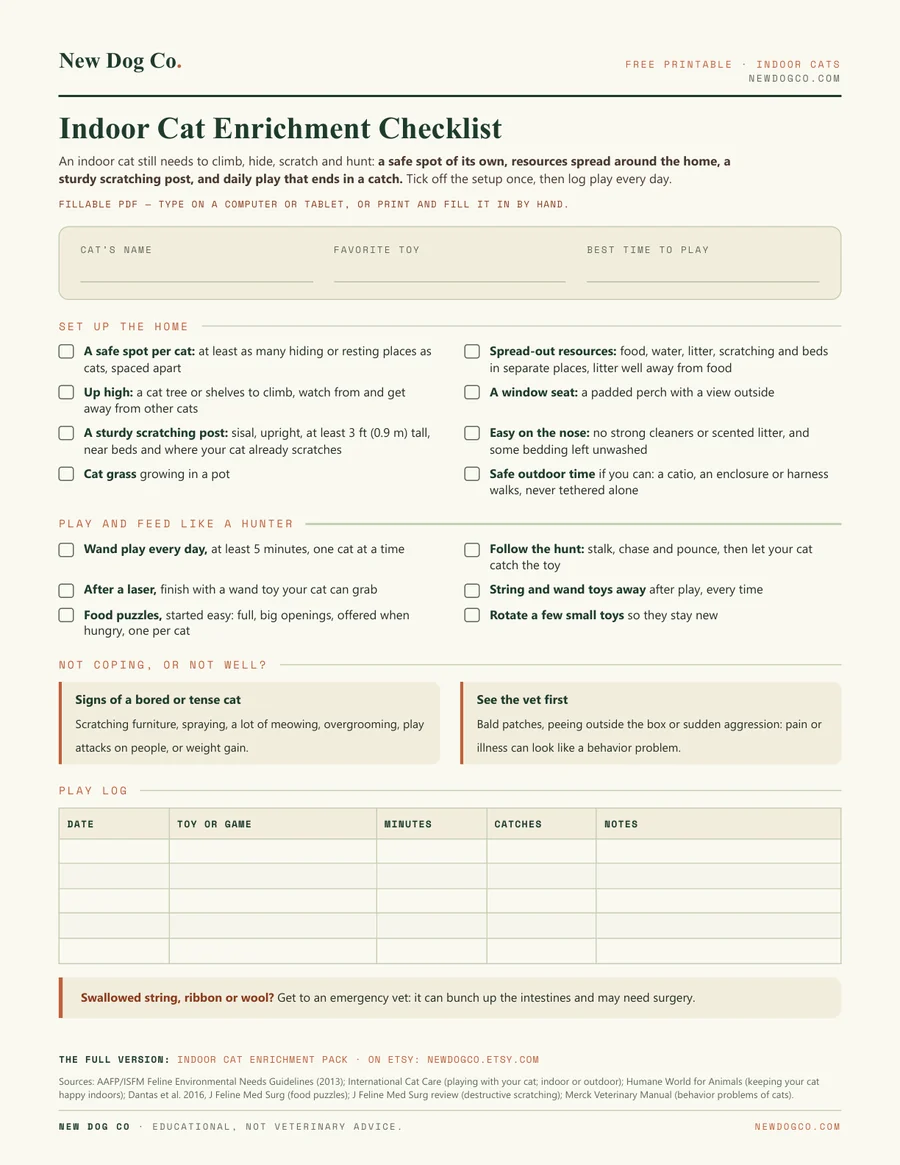
How do you keep an indoor cat happy? Give it what the AAFP and ISFM call the five pillars: a safe place, key resources spread around the home, chances to play and hunt, kind and predictable contact, and respect for its sense of smell. This one-page checklist turns that into things you can tick off, from a safe spot per cat and a sturdy scratching post to daily wand play that ends in a catch, with the signs that a cat is bored or stressed and a log for daily play.
Fillable · bilingual EN/ES · vet-sourced, not a scanned template.
 Got the free sheet? The full version → Indoor Cat Enrichment Pack
What's inside
- Eight home-setup checks, from a safe spot per cat to safe outdoor time
- Six ways to play and feed like a hunter, including food puzzles started the easy way
- Signs a bored or tense cat shows, and the changes that need the vet first
- A fillable play log: date, toy or game, minutes, catches, notes
- The string-and-ribbon warning every cat home needs
How to use it
- Walk through your home with the setup list and tick what is already in place.
- Fix one or two missing items a week, starting with a safe spot and the scratching post.
- Play with a wand toy every day, one cat at a time, and log the minutes and catches.
- If you see the “see the vet first” signs, book a vet visit before changing anything else.
Sources
Vet-sourced: the facts on this sheet come from these sources. It is educational, not veterinary advice.
- AAFP/ISFM Feline Environmental Needs Guidelines (2013)
- International Cat Care (playing with your cat; indoor or outdoor)
- Humane World for Animals (keeping your cat happy indoors)
- Dantas et al. 2016, J Feline Med Surg (food puzzles)
- J Feline Med Surg review (destructive scratching)
- Merck Veterinary Manual (behavior problems of cats)
Published
New printables + calm, sourced dog-care tips
Join the Pack and the 25-printable bundle is your instant thank-you — then we email new printables and short, vet-sourced tips as they’re ready. A few times a month, no spam.
The 25-printable pack lands instantly — new printables and tips follow. Unsubscribe anytime. Privacy Policy.Frequently asked questions
- How can I keep my indoor cat happy?
- Cover the five pillars from the AAFP/ISFM environmental needs guidelines: a safe place, key resources (food, water, litter, scratching, play and rest) in separate places, chances to play and hunt, positive and predictable contact with people, and respect for your cat’s sense of smell.
- How much should I play with my cat?
- Every day. International Cat Care suggests at least five minutes a day with a wand toy, playing with each cat separately, and notes that cats are sprinters, so a minute of all-out play is a good result. For kittens, Humane World for Animals suggests two or three sessions a day of about 15 minutes.
- Are laser pointers bad for cats?
- They can frustrate a cat, because the hunt never ends in a catch. International Cat Care suggests finishing laser play with a wand toy your cat can grab, so every game ends in a catch.
- What makes a good scratching post?
- Sisal, upright, at least 3 feet (0.9 meters) tall and sturdy enough not to wobble, according to a review in the Journal of Feline Medicine and Surgery. Put posts near where your cat sleeps and where it already scratches, reward it for using them, and never punish scratching.
- Do food puzzles help indoor cats?
- They let feeding look like hunting. Start easy, with full puzzles, big openings and a hungry cat, and give each cat its own. In case reports, food puzzles went along with weight loss and fewer behavior problems, though they were usually combined with other changes.
- Can an indoor cat go outside safely?
- Controlled outdoor time, such as a catio, an enclosure or harness walks, adds a lot of stimulation, the AAFP says. Humane World for Animals suggests starting harness training young and never leaving a tethered cat alone.
Free educational printable. Not veterinary advice, and not a substitute for your vet's official records or an emergency call. Full disclaimer → · Leer en español →