IVDD Crate-Rest Daily Log
What does strict crate rest for IVDD look like day to day? A crate or small pen, out only for potty breaks on a harness, medication exactly as prescribed, and no jumping, stairs or play, even when your dog seems fine. The American College of Veterinary Surgeons describes cage rest, confinement and pain medication as the core of non-surgical treatment, and your vet sets how long it lasts, often a few weeks. This one-page log keeps the rules in front of you and gives you a daily record to show your vet.
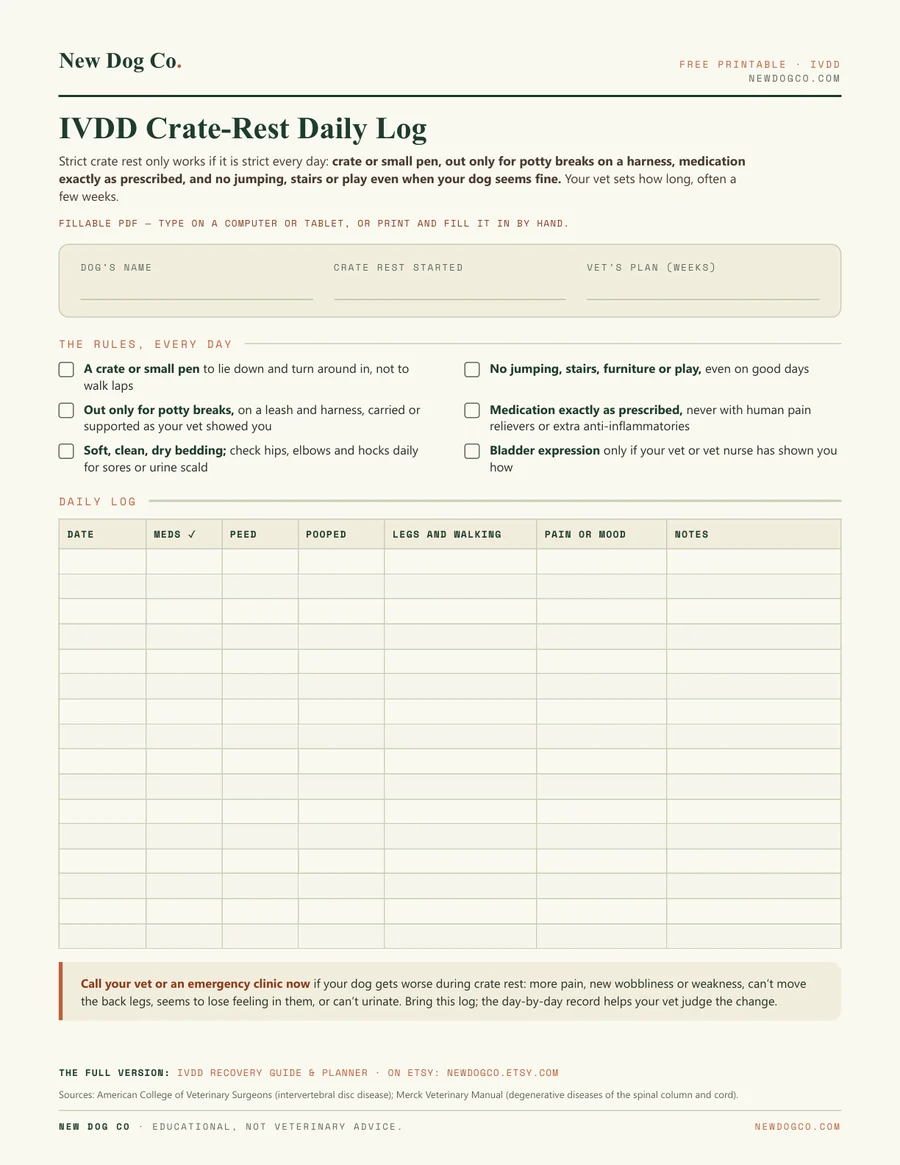
Fillable · bilingual EN/ES · vet-sourced, not a scanned template.
 Got the free sheet? The full version → IVDD Recovery Guide & Planner
What's inside
- The six daily rules of strict crate rest
- A fillable daily log: medication, peeing, pooping, legs and walking, pain or mood, notes
- Skin checks for sores and urine scald, and when bladder expression is needed
- The signs that mean call your vet or an emergency clinic now
How to use it
- Write in the start date and the number of weeks your vet set.
- Fill in one row every day, at the same time, including the good days.
- Check the skin over the hips, elbows and hocks daily, and keep bedding clean and dry.
- Bring the log to every recheck, and call right away if anything gets worse.
Sources
Vet-sourced: the facts on this sheet come from these sources. It is educational, not veterinary advice.
- American College of Veterinary Surgeons (intervertebral disc disease)
- Merck Veterinary Manual (degenerative diseases of the spinal column and cord)
Published
New printables + calm, sourced dog-care tips
Join the Pack and the 25-printable bundle is your instant thank-you — then we email new printables and short, vet-sourced tips as they’re ready. A few times a month, no spam.
The 25-printable pack lands instantly — new printables and tips follow. Unsubscribe anytime. Privacy Policy.Frequently asked questions
- What does strict crate rest mean for IVDD?
- A crate or small pen big enough to lie down and turn around in, but not to walk laps; no jumping, stairs, furniture or play; out only for potty breaks on a leash and harness, carried or supported as your vet showed you; and medication exactly as prescribed, never with human pain relievers.
- How long does IVDD crate rest last?
- Your vet sets it. The Merck Veterinary Manual describes a few weeks of strict cage rest for many dogs, often two to three weeks for dogs with pain and mild to moderate deficits, followed by a gradual return to activity. The American College of Veterinary Surgeons notes that recovery without surgery takes much longer than recovery after it.
- When is IVDD an emergency?
- When your dog can’t walk or move its back legs, can’t urinate, seems to have lost feeling in its legs, or is getting worse over hours. The American College of Veterinary Surgeons describes disc rupture as generally a surgical emergency, so go to your vet or an emergency clinic straight away.
- Can a dog with IVDD recover without surgery?
- Many do. The American College of Veterinary Surgeons reports that 60 to 80% of dogs that can still feel pain in their legs recover with strict medical management, compared with about 90% after surgery. For dogs that have lost pain perception, the figures are under 10% with medical management and 50 to 60% with surgery.
- How do I prevent bed sores during crate rest?
- Dogs that can’t walk are at higher risk of bed sores, urine scald and urinary infections, according to the American College of Veterinary Surgeons. A soft, well-padded surface helps; keep the bedding clean and dry and check the skin over the hips, elbows and hocks every day.
- Will IVDD come back?
- It can. The American College of Veterinary Surgeons reports that about 25% of dogs have another disc herniation later in life, and the Merck owner guide puts recurrence of signs at 30 to 40%. Weight control, a harness instead of a neck lead and less jumping off furniture all help.
Free educational printable. Not veterinary advice, and not a substitute for your vet's official records or an emergency call. Full disclaimer → · Leer en español →