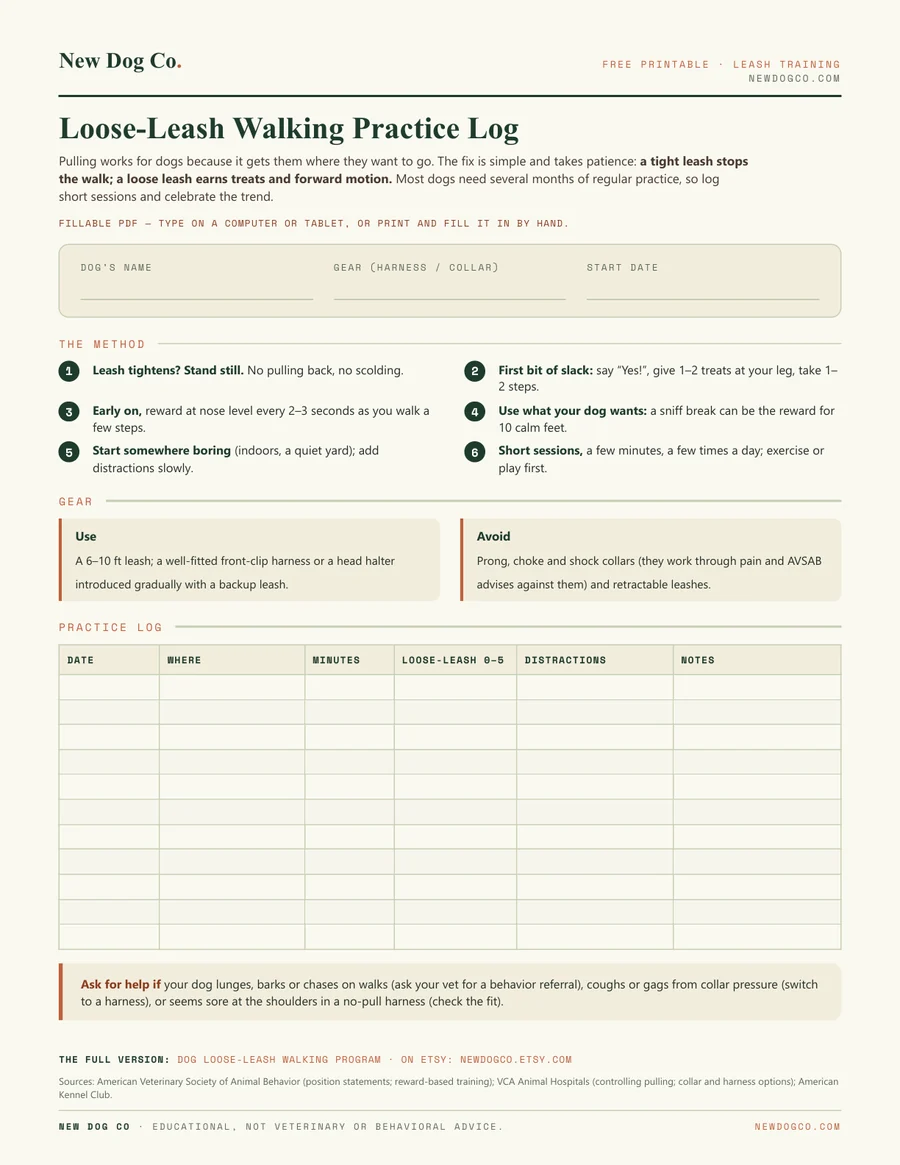
Loose-Leash Walking Practice Log
How do you stop a dog from pulling on the leash? Make pulling stop the walk and a loose leash pay: stand still when the leash tightens, and the moment it slackens, mark it, reward at your side and take a step or two. VCA Animal Hospitals describes this method, and the American Veterinary Society of Animal Behavior recommends reward-based training only. This one-page log gives you the method in six steps, the gear to use and avoid, and a practice log, because most dogs need several months of regular practice.
Fillable · bilingual EN/ES · vet-sourced, not a scanned template.
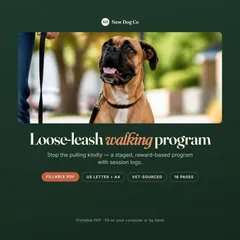 Got the free sheet? The full version → Dog Loose-Leash Walking Program $3.73
 What's inside
- The stop-and-reward method in six steps
- Gear: what helps (front-clip harness, head halter, 6–10 ft leash) and what to avoid (prong, choke, shock collars, retractable leashes)
- A fillable practice log: date, place, minutes, loose-leash score, distractions, notes
- When to ask for professional help
How to use it
- Start indoors or in a quiet yard, and exercise or play with your dog first.
- Practise a few minutes at a time, a few times a day, and score the loose leash 0–5.
- Add distractions only when the score stays high in the easy places.
- Watch the trend over weeks; most dogs need several months of practice.
New printables + calm, sourced dog-care tips
Join the Pack and the 25-printable bundle is your instant thank-you — then we email new printables and short, vet-sourced tips as they’re ready. A few times a month, no spam.
The 25-printable pack lands instantly — new printables and tips follow. Unsubscribe anytime. Privacy Policy.Frequently asked questions
- How long does loose-leash training take?
- VCA says most dogs need several months of regular practice. Short, frequent sessions in easy places, building up to distractions slowly, work better than long walks where the dog keeps pulling.
- Is a prong or shock collar faster?
- The American Veterinary Society of Animal Behavior recommends only reward-based methods and links aversive methods to fear, anxiety and stress. VCA notes that choke, prong and shock collars rely on pain, and that choke and prong collars can injure the windpipe.
- Front-clip harness or head halter?
- Both reduce pulling, according to VCA. A well-fitted front-clip harness is easy to start with; a head halter needs gradual introduction and a second, backup leash.
- What if my dog lunges or barks at other dogs on walks?
- That’s more than pulling. VCA suggests asking your vet for a referral to a behavior professional, and the site’s reactive-dog resources explain how to work below your dog’s threshold.
Free educational printable. Not veterinary advice, and not a substitute for your vet's official records or an emergency call. Full disclaimer → · Leer en español →