Why Is My Dog Reactive on Leash but Not Off?
Why the same dog can be a calm angel off-leash and a barking tornado on it — and what actually helps.
On this page
Your dog is reactive on leash but fine off leash because the leash takes away his main coping skill — distance. It’s the leash, not your dog. Off leash, he can move away from whatever worries him (another dog, a jogger, a bike) and never needs to make a scene. On leash that exit is gone, so the next-best way to make the scary thing back off is to bark, lunge, and look big. Same dog, different toolkit.
Most people read this backwards — they assume the off-leash calm is the “real” dog and the on-leash blowup is a behavior problem to correct. It’s the reverse: the leash is the variable, not your dog’s temperament. Once you see it that way, the fix stops feeling mysterious. (It runs on the same method as our complete guide to reactive dogs.)
Does the leash itself cause the reactivity?
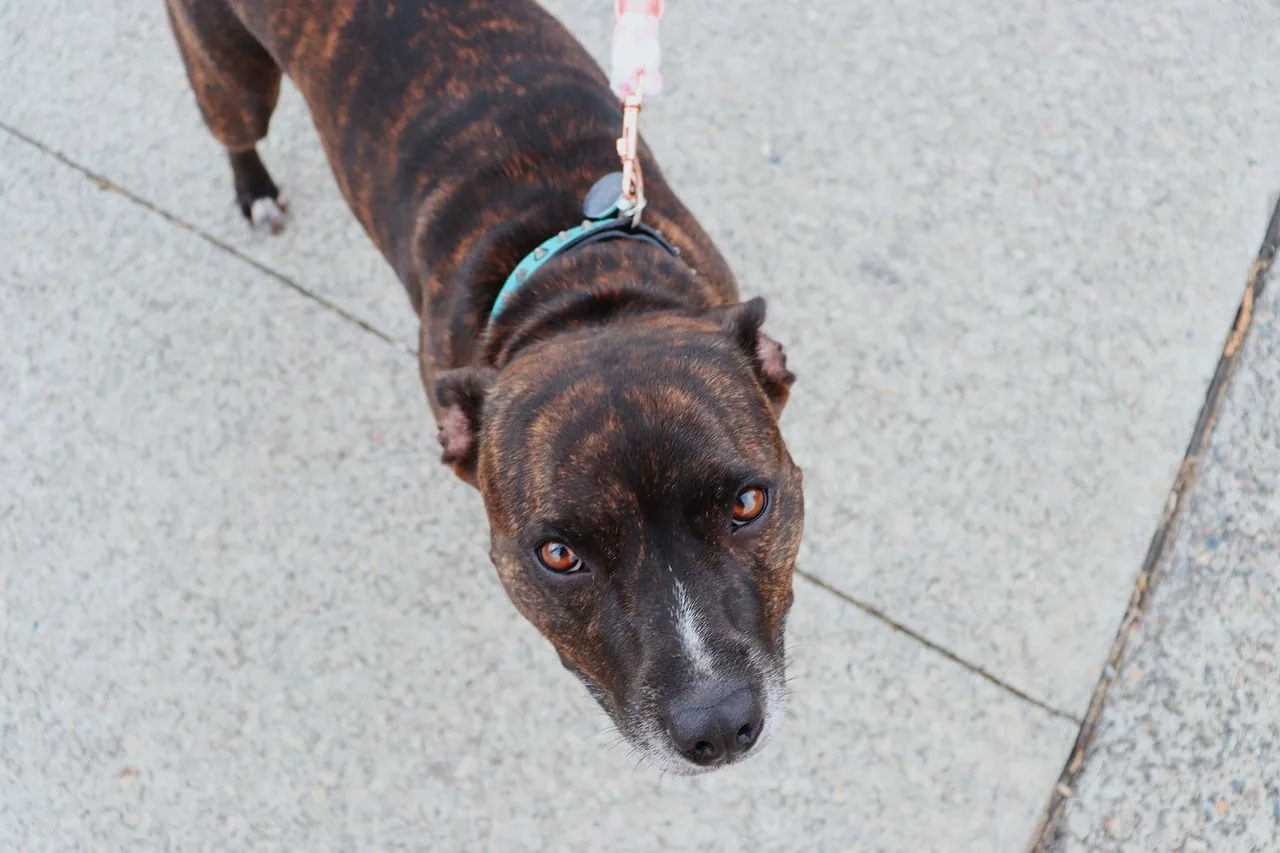
Mostly, yes — the leash takes away your dog’s number-one coping skill: distance. A leashed dog is working without his main exit, so a small worry has no quiet way out before it boils over.
Off leash, a worried dog has choices. He can sniff the grass, arc around the other dog, or simply leave. Each small choice lets the pressure out.
Clip on a leash and every one of those choices disappears. He’s tethered six feet from you and can’t add a single foot of space on his own. The only levers left are the loud ones. (For a social dog who’s blocked from saying hi, trainers call that specific version “barrier frustration.”)
It’s the same reason a calm person can feel panicky stuck in a middle seat on a packed plane. Nothing changed about who they are — their options did.
Why is my dog calm at the park but reactive on the sidewalk?
Picture it. At the off-leash park your dog is a dream: he trots up to a Lab, does a polite sniff, then bounces off to chase a ball. You think, see, he’s great with other dogs.
Then a leashed walk down your own street. A dog appears across the road and your dog detonates — barking, lunging, up on his back legs — while you stand there apologizing to a stranger and hauling on the leash, your face hot.
It feels like you own two different dogs. You don’t. It’s one dog, with and without an escape hatch.
And slowly the walk turns into a stakeout. You start scanning every parked car and blind corner before he does. You cross the street to dodge the retriever on the next block. You move the walk to 6 a.m. so nobody’s out. That constant vigilance is exhausting, and the embarrassment is real.
None of it means you’re failing. It means the problem needs to be made smaller — not that the walks need to be given up.
Is my dog being protective, scared, or just frustrated?
Reactivity is almost never aggression, and it’s usually not “protecting” you either. Underneath it is one of two feelings: fear or frustration.
Fear says make it go away. The dog wants more distance and uses noise to buy it. Learning to spot the early, quiet signs of that fear — the lip licks, the whale eye, the freeze — is its own skill; here’s how to read your dog’s body language before a bark ever happens.
Frustration says let me AT it. This is the friendly, social dog who desperately wants to greet, can’t, and throws a tantrum at the end of the leash.
A useful clue is what your dog already does off leash, in safe, fenced settings. If he relaxes and ignores the other dog once he’s free, lean toward fear. If he sprints over to play, lean toward frustration. The fix differs, so it’s worth watching.
Either way, this is a dog having a hard time — not a “dominant” or “bad” one. That distinction matters, because it tells you what not to reach for next.
Will punishing the barking fix it?
No — and it usually backfires. If the reactivity is fear-based, a leash pop, a yell, or a shock teaches your dog that the scary thing now predicts pain on top of fear. He feels worse about the trigger, not better.
Punishment can also teach a dog to swallow his warning growls. A dog who’s learned not to warn is more dangerous, not less — that’s how “he bit with no warning” stories start.
This is why this guide, and the major credentialed behavior bodies, stick to reward-based methods only — no prong, choke, or shock collars. The American Veterinary Society of Animal Behavior (AVSAB), in its 2021 Humane Dog Training Position Statement, is explicit that aversive tools raise fear, anxiety, and aggression risk, and the AVMA backs reward-based methods.
How do I help my dog feel calmer on leash?
The goal isn’t to drag your dog closer to triggers until he “gets used to it.” It’s the opposite: give back the distance the leash took away, on purpose.
Work at a distance where your dog notices the trigger but can still eat, glance at you, and walk on. Trainers call that being under threshold — get too close and no learning happens, only panic. The full breakdown of thresholds and the Three Ds lives in our guide to helping a leash-reactive dog.
At that calm distance, play the simplest game there is: the trigger appears, you start handing over chicken; the trigger leaves, the chicken stops. After enough reps, another dog stops meaning dread and starts meaning dinner.
Give your dog an exit, too. Teach a cheerful U-turn at home until it’s a reflex, arc around other dogs instead of marching straight at them, and use parked cars and hedges as visual shields. Every walk he doesn’t explode is one less rehearsal of exploding.
Gear that helps: a front-clip harness, a fixed (non-retractable) six-foot leash, and high-value food — real chicken or cheese, because kibble won’t outbid a trigger. Skip anything that works by causing pain.
Keep sessions short and end on a win. Progress isn’t “never reacts.” It’s reacting later, recovering faster, at shorter distances, with more check-ins with you.
When should I get a trainer or behaviorist?
See your vet first — pain is the single most-missed reason a dog “suddenly” starts reacting, so a real change in behavior is a medical question as much as a training one.
Then, if there’s been a bite or near-bite, if things are getting worse, or if you simply feel out of your depth, bring in a credentialed, reward-based professional. Look for a certified trainer (CCPDT), a behavior consultant (IAABC), or a veterinary behaviorist (DACVB). For a higher-risk dog, a basket muzzle — introduced slowly and paired with treats so he’s glad to wear it — is welfare, not shame, and buys everyone room to work. This article is educational, not a substitute for hands-on veterinary or behavior care.
Leash reactivity isn’t a life sentence, and it isn’t a verdict on you or your dog — it’s a skills gap with a clear plan behind it. If you want that whole plan in one place, our Reactive Dog Toolkit is the full step-by-step system to start working on it: how to read thresholds, the distance work, the gear, and the daily games that turn the sidewalk tornado back into your off-leash angel.
Frequently asked questions
- Will my dog grow out of leash reactivity?
- Usually not on its own. Left alone it tends to get *more* practiced, because every blow-up appears to "work" — the trigger goes away. The good news is it responds well to calm, reward-based practice, often faster than owners expect.
- Should I avoid other dogs completely?
- No — just avoid close, over-threshold surprises. Distance is a tool, not a life sentence. You want your dog to keep seeing other dogs, only far enough away that he can stay calm and get paid for it.
- Is leash reactivity the same as aggression?
- No. Reactivity is an over-reaction driven by fear or frustration; aggression is behavior meant to threaten or do harm — and even that is often fear-driven. Most reactive dogs are loud, not dangerous, but ignored reactivity can drift over time, which is exactly why gentle, early work matters.
- Can I fix this myself, or do I need a trainer?
- Mild cases often improve with consistent at-home practice. If there's any bite history, escalation, or you feel stuck, a certified reward-based trainer or veterinary behaviorist will get you there faster and more safely.
Educational content only — not veterinary or professional behavior advice. Consult your vet, or a certified trainer or behaviorist, for your pet. Read the full disclaimer →