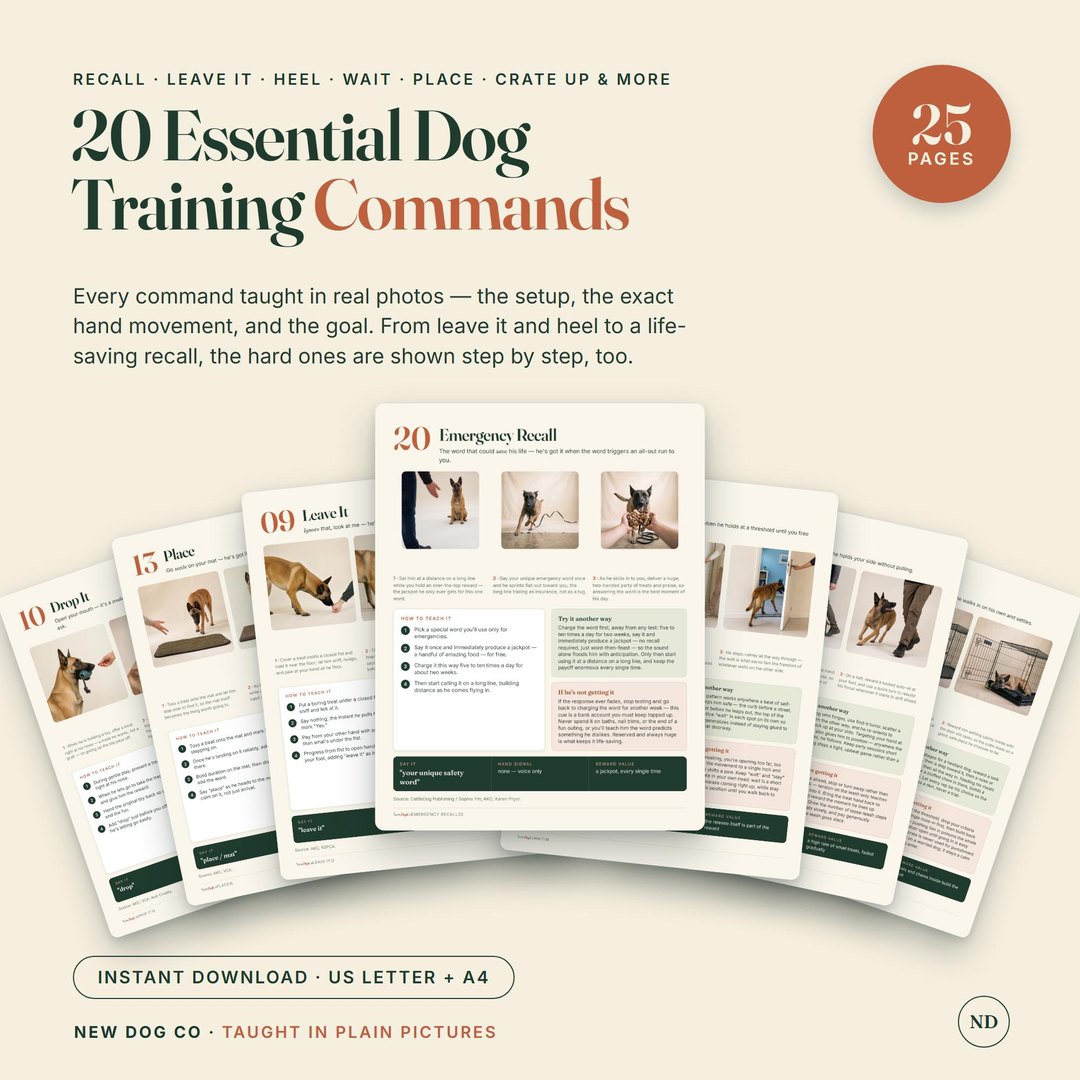
The core set of cues, and why these ones
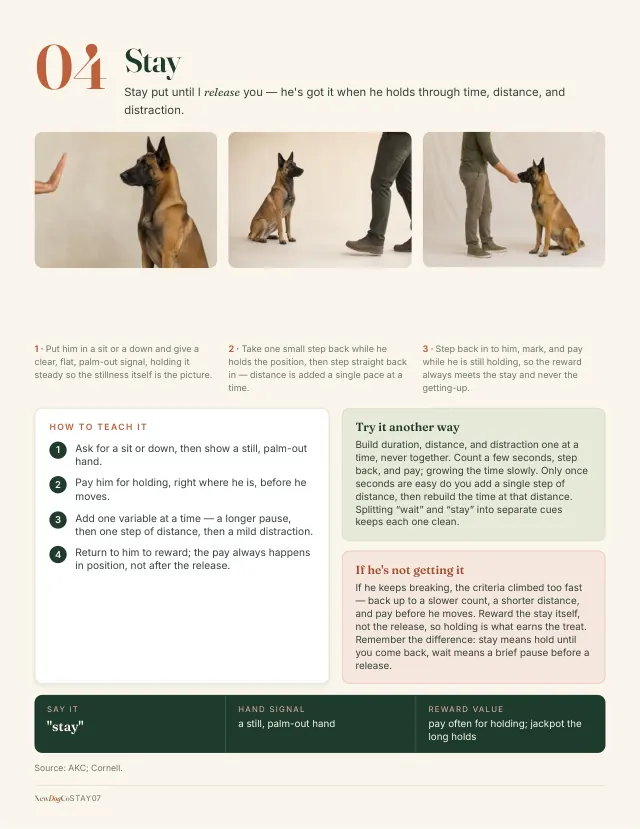
A dog does not need a long list of tricks to live well with people. It needs a small set of reliable cues that keep it safe and make daily life predictable. This guide organizes about twenty cues around that goal, starting with the foundation ones almost everything else is built on: name or attention (your dog looks at you when you say its name), sit, down, and stay.
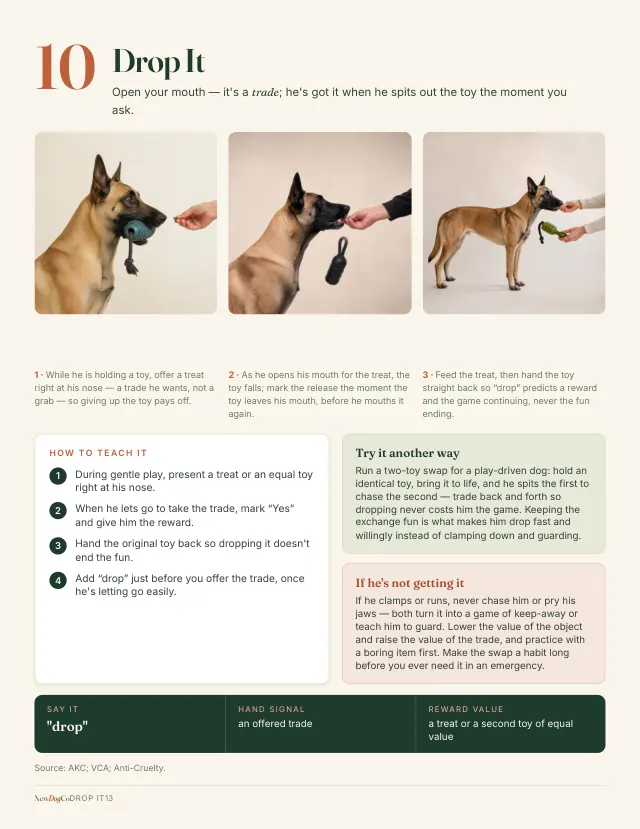
From there it adds the cues that prevent real problems: come (a recall you can trust), leave it (do not pick that up), drop it (release what is already in the mouth), place (go to a mat and stay there), loose-leash walking, and settle (relax on your own). These are the ones owners actually reach for at a busy door, near dropped food, or on a walk past another dog. The remaining cues in the set are variations and life-skill add-ons, but the ten above carry most of the daily weight.
The point of teaching them formally is consistency. When the whole household uses the same word for the same behavior and rewards it the same way, the dog learns faster and guesses less.
The method: lure, mark, reward, then fade
Nearly every cue in this guide uses the same four-part loop, so it is worth learning once.
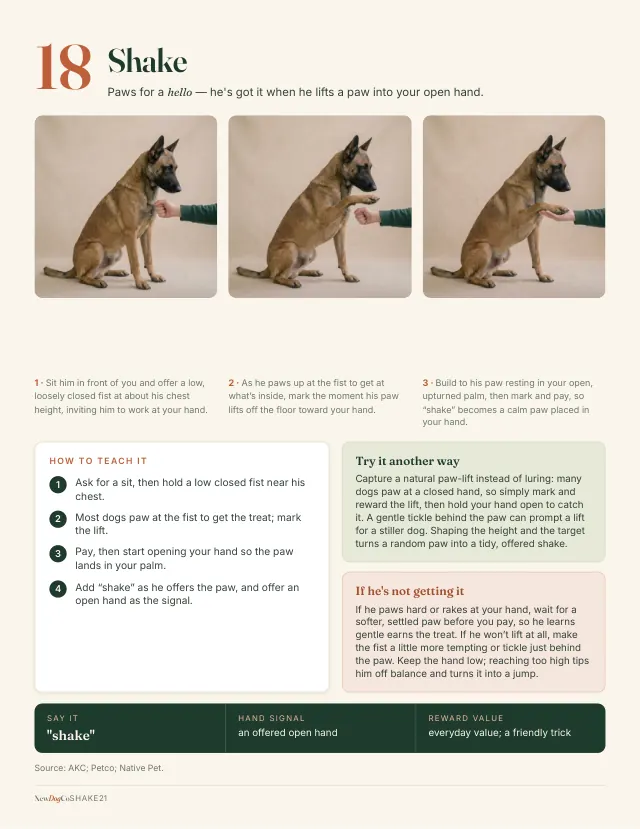
Lure: use a treat or your hand to guide the dog into the position or action you want. For sit, a treat lifted just over the nose usually tips the head back and drops the rear. You are not forcing the body; you are making the right choice easy.
Mark: the instant the behavior happens, give a consistent signal that means "yes, that." A clicker works, or a short word like "yes" said the same way every time. The mark is about timing. It tells the dog exactly which split-second earned the reward, which is the single thing most beginners get wrong.
Reward: deliver the treat right after the mark. The mark buys you a second or two, so the reward does not have to be instantaneous, but it should follow quickly and reliably.
Fade: once the dog offers the behavior easily, stop leading with food. Make the same hand motion empty, then shrink it toward a small signal, and reward from your other hand or pocket afterward. Fading early is what keeps you from ending up with a dog that only responds when it sees a treat.
Worked examples: sit, come, and leave it
Sit. Hold a treat at your dog's nose, then move it slowly up and slightly back over the head. As the nose follows up, the rear tends to go down. The moment the rear touches the floor, mark and reward. After several clean reps, do the same motion with an empty hand, reward from the other hand, and add the word "sit" just before the hand signal so the word starts to predict the behavior.
Come. Start in a boring, low-distraction room. Say your dog's name and "come" once in a bright voice, then move backward a step or two to make chasing you fun. Mark as the dog commits toward you and reward generously when it arrives, ideally with something better than the everyday treat. Never call "come" and then do something the dog dislikes, and avoid repeating the word if it does not move. Build up to a long line outdoors before you ever trust recall off leash.
Leave it. Place a low-value treat under your covered hand on the floor. Let the dog sniff, lick, and paw. The instant it backs off or looks away, mark and reward from your other hand with a different, better treat. Repeat until the dog turns away on its own, then add the words "leave it" and gradually work up to an uncovered treat, then dropped food, then objects on walks. The dog learns that turning away pays better than grabbing.
Why reward-based training, not corrections
How you teach matters as much as what you teach. The American Veterinary Society of Animal Behavior states that training should be based on reward-based methods and advises against aversive techniques such as shock, prong, or choke tools, physical corrections, and intimidation, because they carry a real risk of causing fear, anxiety, and aggression. The ASPCA and AAHA give similar reward-first guidance.
The practical reason is simple. Punishment may stop a behavior in the moment, but it does not teach the dog what to do instead, and it often teaches the dog to be wary of you or of the situation. A dog that has been corrected around food may guard it harder. A dog startled by a leash pop near another dog may start associating other dogs with something unpleasant. Reward-based training avoids that fallout by paying the behavior you want, so the dog chooses it more often on its own. It also protects the relationship, which is the thing that makes every future cue easier to teach.
Sessions, timing, and reading progress
Dogs learn in short bursts. A few minutes, two or three times a day, beats one long drilling session, and it ends before your dog gets bored or frustrated. Stop while things are still going well so the last rep your dog remembers is a good one.
Work one piece of difficulty at a time. Trainers often talk about duration (how long), distance (how far), and distraction (what else is going on). Raise only one of those at a time. If you add all three at once, most dogs fall apart, and you will not know which one was too much. Set a clear criterion for each rep, for example "sit and hold for two seconds," and only stretch it once the dog is succeeding roughly four out of five tries.
This is where the fillable trackers earn their place. Logging reps and rough success rate turns vague impressions into something you can read. If "come" is reliable in the kitchen but falls to half in the yard, the tracker shows you exactly where to spend the next week rather than declaring the cue "trained" too early. Reliability is built context by context, and writing it down is how you keep yourself honest about it.