
Why recall breaks down (and it is almost never stubbornness)
When a dog stops coming when called, owners tend to read it as defiance. It is usually something more mechanical: the cue has stopped predicting anything good. Three patterns cause most failures.
The poisoned cue. If "come" has been followed by nail trims, leaving the park, a bath, or a scolding, the word now predicts the end of fun or something unpleasant. The dog is not ignoring you; the word means "the good part is over." AVSAB's position on humane training stresses that behavior follows consequences, and a cue paired with bad outcomes gets weaker.
Calling only to end things. If the only time you call is to clip the leash and go home, coming back reliably gets punished by losing freedom. The fix is to call often, pay, and release the dog back to play so recall predicts a bonus, not a loss.
Punishing the return. A dog that comes back late and gets yelled at learns that returning is risky. From the dog's point of view, the last thing that happened, coming to you, is what got punished. The ASPCA and AAHA both emphasize reward-based methods precisely because punishment suppresses the behavior you want more of.
Choose a fresh cue and load it with meaning
If your current recall word is worn out, retire it. Pick a brand-new cue the dog has no history with: a distinct word ("here," "now," a whistle pattern) said in an upbeat, consistent tone. Everyone in the house uses the same one.
Then charge it before you ever ask for anything. This is classical conditioning: say the cue, then immediately deliver a high-value treat, whether or not the dog moved. Ten to fifteen reps a session, several sessions a day, in a quiet room. You are building a reflex where the word itself sparks a happy expectation.
High-value means high-value to the dog, not to you. A dry biscuit will not outbid a squirrel. Use small pieces of real chicken, cheese, or freeze-dried liver, delivered fast and in quantity for the best recalls. Rank your dog's rewards from everyday to jackpot, and save the jackpot for hard recalls. The AVSAB guidance on reinforcement is blunt: the reward has to matter to the animal, or it will not compete with the environment.
Foundation games that build the habit
Recall is a trained reflex, and reflexes come from cheerful repetition, not solemn drilling. Play these in easy settings first.
- Name game. Say the dog's name, mark the head-turn with a "yes," and pay. This teaches that orienting to you is always worth it, the first half of any recall.
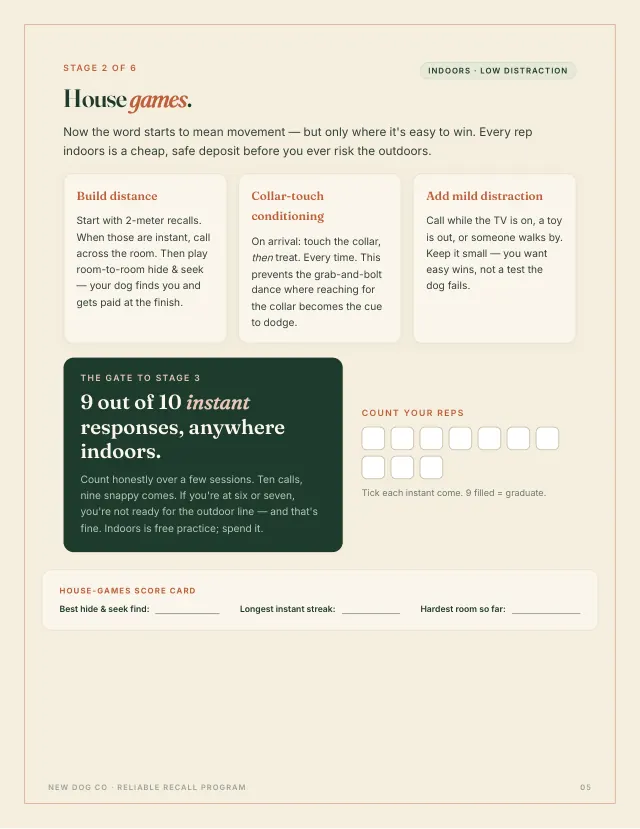
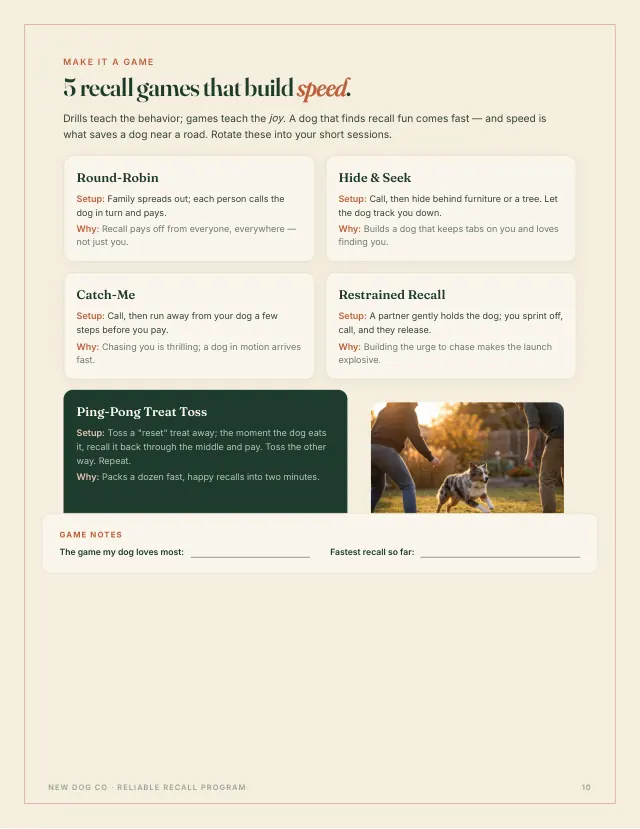
- Ping-pong recall. Two people ten feet apart, each calls the dog in turn and pays on arrival. The dog runs a happy shuttle, banking dozens of paid recalls in minutes.
- Chase-me. Call, then run backward a few steps so the dog chases you in. Movement away from a dog is magnetic; it makes coming fast and fun instead of a compliance test.
- Reward scatter. After the dog reaches you, toss a few treats on the ground. The dog eats, then naturally re-engages, and you can call again. It also teaches that coming to you does not mean instant leashing.
Keep sessions short, two to five minutes, and stop while the dog still wants more. End on an easy win.
Proofing across the 3 D's
A recall that works in your kitchen is not the same skill as one that works at a trailhead. You generalize it by climbing three separate ladders, changing only one at a time.
Distance. Start a few feet away and add distance gradually. If the dog fails, you jumped too far, too fast; shrink the gap and rebuild.
Duration. Add a beat between the cue and the reward, and practice recalling the dog out of a mild activity like sniffing, so coming works even when the dog is already occupied.
Distraction. This is the hardest D and the one that breaks recalls in real life. Add distractions in tiny increments: a familiar person, then a toy on the ground, then another dog at a distance, then a park at a quiet hour. If the dog cannot succeed, the distraction is too strong or too close, so back off. Only raise one D at a time; raising all three at once is how recalls collapse. Keep paying generously the whole way up, because you are asking the dog to choose you over increasingly interesting things.
The long-line stage and what to never do
Before you trust a recall off-leash, bridge the gap with a long line: a 15 to 30 foot leash on a harness (not a collar, to protect the neck from sudden jerks). The long line lets the dog experience distance and distraction while giving you a safe way to prevent a failed recall from being rehearsed or self-rewarding. Let it drag, keep it from tangling, and use it to gently prevent bolting, never to yank or correct. Practice here for weeks, not days, until recall is close to automatic in the environments you care about.
What to never do: never punish a dog that comes back, even if it took too long, even if it ran off first. The moment it reaches you is the moment you are training; make it the best moment of the walk. Do not chase a dog that will not come, which turns it into a game of keep-away, run the other way instead. Skip prong collars, shock, and "be the pack leader" advice; the ASPCA, AAHA, and AVSAB all warn that aversive tools raise fear and aggression and damage the trust recall depends on. A reliable recall is a bank account: every paid, punishment-free return is a deposit, and you never make a withdrawal.