Why a pet-care business needs real paperwork
Most small pet-care businesses start on trust and text messages. That works right up until it doesn't: a client disputes a cancellation charge, a dog gets loose, or a pet needs emergency care while the owner is unreachable. Written forms are how you set expectations before a problem, and how you show what was agreed to after one.
Paperwork also signals that you run a real operation. Clients hand over house keys and a living animal, so the professionalism of your intake process is part of what they are buying. The forms below are the common backbone of a dog walking, sitting, or grooming business. Not every business needs every form on every job, but knowing what each one does helps you decide what to send.
One thing these templates cannot do is replace legal advice. They are a starting draft you edit to fit your rates, your rules, and the law where you work. Before you rely on them, ask a licensed attorney to review them.
The service agreement: scope, schedule, and cancellation
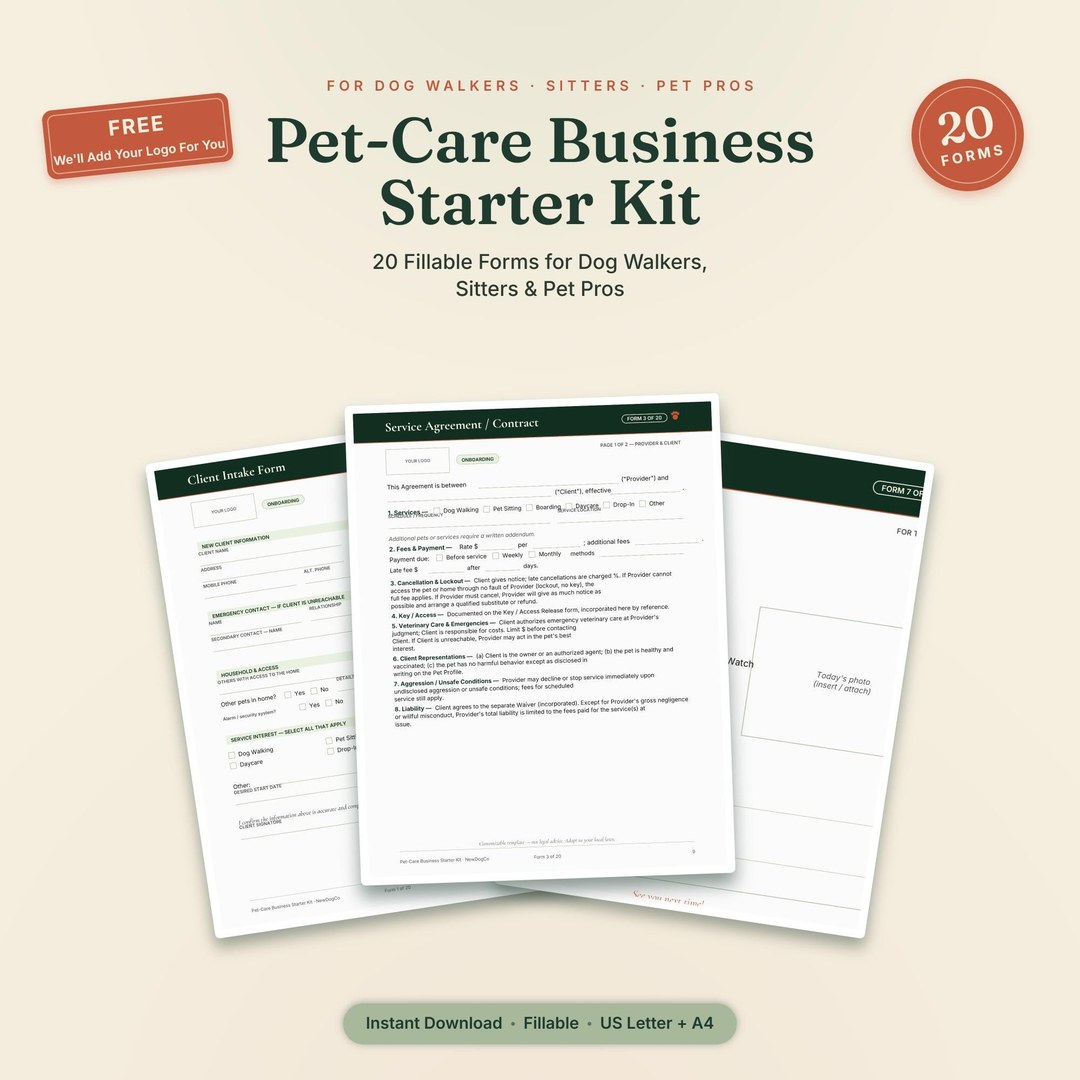
Think of the service agreement as the contract that defines the working relationship. Its job is to remove ambiguity about four things: what you will do, when, for how much, and what happens when plans change.
- Scope: exactly which services are included. A 30-minute walk is different from a walk plus feeding plus a medication dose. Spell it out so nobody assumes an add-on is free.
- Schedule: visit times or windows, start and end dates, and how recurring bookings roll over.
- Payment: your rate, when payment is due, deposits, late fees, and accepted methods.
- Cancellation: the single most common source of disputes. State a clear window, for example "cancel more than 24 hours out for a full refund; inside 24 hours is charged at 50%." Pick numbers you can defend and apply them consistently.
A signed agreement protects both sides. The client knows the price won't move; you know a last-minute cancellation won't wipe out a day you held open.
Intake, vet release, and key release: the safety trio
Three forms carry most of the real-world risk in pet care, and they work together.
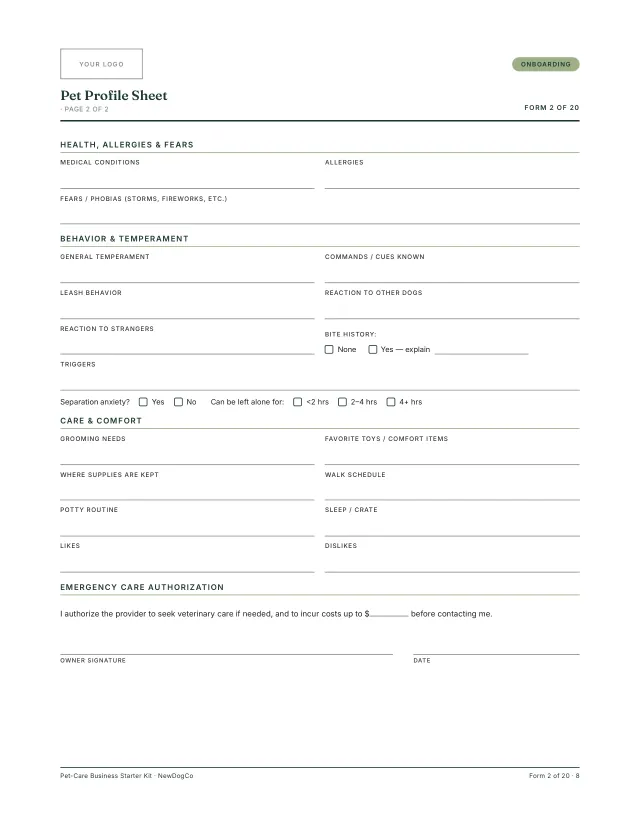
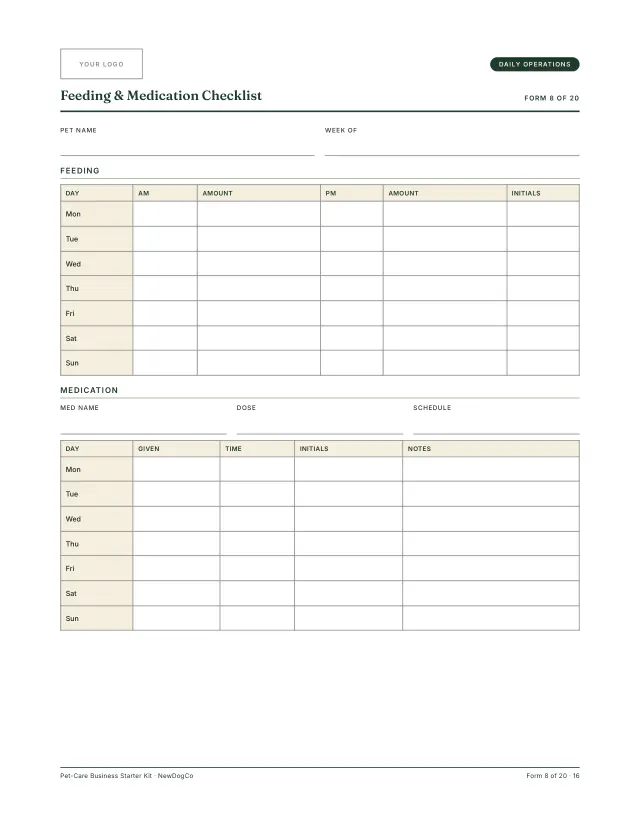
Client and pet intake is your operational memory. It captures the owner's contact details, the pet's name, breed, age, and any behavioral notes, plus the two fields that matter most in a crisis: the regular veterinarian and a reachable emergency contact who can make decisions if the owner can't. The ASPCA's guidance on pet emergency preparedness stresses keeping your vet's number and an out-of-area contact written down and accessible rather than trusting memory. Add feeding instructions, medications and doses, allergies, and known triggers or reactive behaviors so the person on the visit isn't guessing.
Veterinary treatment authorization is the form that lets you act when a pet is hurt and the owner is unreachable. It records the owner's consent to seek care, ideally names a preferred clinic, and can set a spending cap the owner is comfortable with before they must be reached. Without it, a vet may hesitate and you may be stuck making an expensive call with no written authority. The American Animal Hospital Association (AAHA) notes that informed consent for treatment is standard veterinary practice; your release is what supplies that consent in advance.
Key release and access log documents something that makes many clients nervous: who holds a key or door code, when it was handed over, and when it comes back. A simple log of dates and signatures protects you from a later "how did you get in" question and shows you take home access seriously. Note the access method, any alarm codes handled separately and securely, and the return date.
Liability waiver and invoice: closing the loop
A liability waiver, sometimes framed as an assumption-of-risk acknowledgment, states that the client understands animals are unpredictable and that certain risks come with walking, boarding, or grooming. It does not make you immune from your own negligence, and the degree to which any waiver holds up depends entirely on local law, which is exactly why an attorney should review the language. Treat it as a clarity-and-expectations document, not a magic shield.
The invoice is the least dramatic form and the one you'll use most. A clean invoice lists the service, date, rate, total, and payment method, and it doubles as a receipt for the client and a record for your own bookkeeping. Consistent invoices make quarterly taxes far less painful and make you look like the professional you are.
Used together, these six forms turn a casual side gig into a documented business: agreed scope, captured emergency information, authority to act, recorded access, acknowledged risk, and clean payment records.
An important legal note before you use these
These are editable templates, not legal advice, and not a substitute for a lawyer. They have not been reviewed by an attorney for your jurisdiction, they are not guaranteed to be legally valid or enforceable, and they have not been tested in any court. Contract, liability, and consent rules vary widely by state, province, and country.
Before you use any of these forms with a paying client, have a licensed attorney in your area review and adjust the wording for your business and your local law. Fill in your real rates, cancellation window, and service terms, keep signed copies, and update the forms whenever your services or the law change. The value here is a professional, organized starting point that saves you drafting time; the legal sign-off has to come from a professional near you.