Why a written record beats a gut feeling
Caring for a declining dog is emotionally exhausting, and memory is a poor instrument under stress. A great morning can erase the memory of three hard days; a single bad afternoon can make everything feel hopeless. Neither reaction reflects the real trend.
Writing it down changes that. A simple daily score converts a wrenching, shifting feeling into something you can actually look at. Over two or three weeks, a written record shows whether your dog is holding steady, slowly declining, or improving on a new medication — a pattern no single day can reveal.
This mirrors how veterinary teams think about chronic illness. The American Animal Hospital Association's end-of-life care guidelines emphasize structured, ongoing quality-of-life assessment and open communication with the family rather than a one-moment decision. A tracker gives you the raw material for that conversation. It will not tell you what to do, but it replaces "I think she's getting worse" with dated evidence you and your veterinarian can read together.
The Villalobos HHHHHMM Quality-of-Life Scale
The scale this tracker uses was developed by Dr. Alice Villalobos, a veterinary oncologist, and is one of the most widely referenced quality-of-life tools in veterinary hospice and palliative care. It is nicknamed HHHHHMM for its seven categories, each scored from 0 to 10:
- Hurt: is pain controlled, and is the dog breathing comfortably?
- Hunger: is the dog eating enough, with help or hand-feeding if needed?
- Hydration: is the dog drinking and staying hydrated?
- Hygiene: can the dog be kept clean and free of sores, especially after accidents?
- Happiness: does the dog still show interest, respond to family, and enjoy anything?
- Mobility: can the dog move enough to relieve itself and shift position comfortably?
- More good days than bad: do the good days still outnumber the bad?
Villalobos suggested that a total consistently around 35 or above (of 70) supports acceptable quality of life. Treat that as a guide for discussion with your veterinarian, not a verdict.
How to score honestly
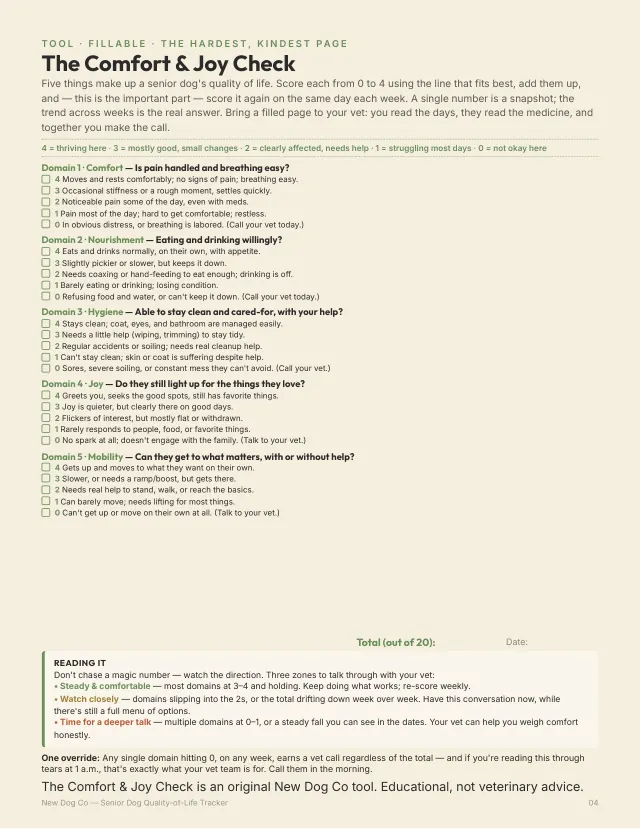
The tracker only helps if the numbers are accurate, and objectivity is hard when you love the patient. Two habits protect the record. First, score what you actually observed today, not what you hope tomorrow will bring. Second, define your own anchors: decide in advance what a 3, a 6, and a 9 look like for your dog on each category, so a "5" means the same thing on Monday and Friday.
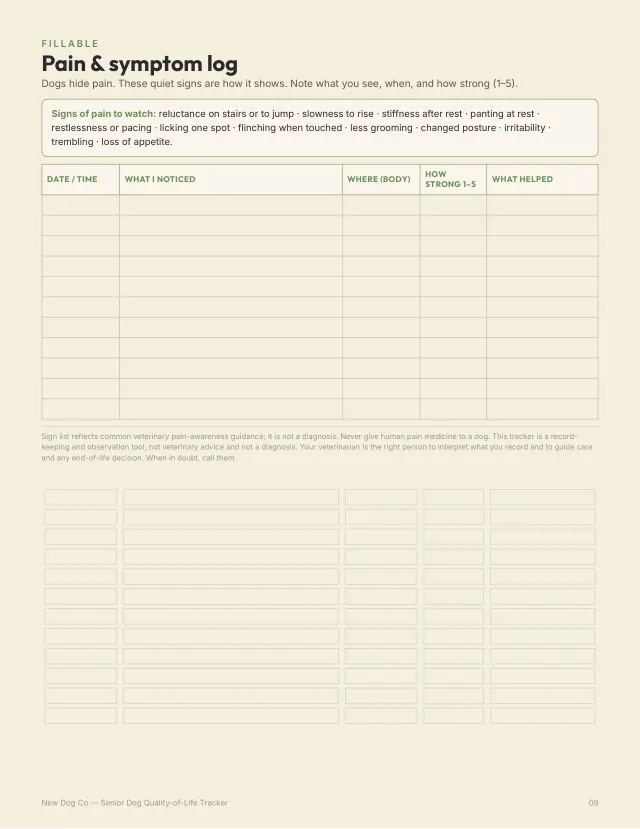
Watch for pain you might be missing. Dogs rarely cry out; discomfort more often shows as reluctance to move, a hunched posture, panting at rest, restlessness, or withdrawal from the family. The American Animal Hospital Association's pain management guidelines note that behavior change is often the clearest sign of chronic pain in dogs. Note appetite and water intake carefully too, since both fall as many illnesses advance.
If several people share care, agree on the anchors together so one person's "good day" is not another's "bad day." Consistent scoring is what makes the weekly trend trustworthy.
Tracking the good-days-vs-bad-days ratio
Of all seven categories, the last one — more good days than bad — often carries the most weight in real decisions, and it is the one memory distorts most. That is why the tracker asks you to mark every single day, not to summarize a week from recall.
The method is simple. Each day, after scoring, mark it good or bad by your own candid standard: was your dog comfortable, interested, and able to do a few things it enjoys, or was it mostly a day of struggle? At the end of each week, count both columns. A run of five good days out of seven reads very differently from two, and a slow shift from mostly-good toward mostly-bad is exactly the trend that is invisible day to day.
This ratio is not a stopwatch and it does not make the decision for you. What it does is anchor an unbearable question in something real, so that when you sit down with your veterinarian you are describing a pattern you can both see rather than a single frightening morning.
Bringing the record to your veterinarian
The tracker's real payoff is the conversation it makes possible. Arriving with two or three weeks of dated scores changes the appointment from "how has she been?" — a question grief makes almost impossible to answer well — into a shared reading of a real trend.
Use the prep page to write your questions down before you go, because they are easy to forget in the room. Good ones include: Is my dog's pain actually controlled, and can more be done? What does this trend suggest about the weeks ahead? What are the signs I should watch for? and When you think about hospice or saying goodbye, what would you consider? The American Veterinary Medical Association encourages open, values-based discussion of end-of-life care between families and their veterinary team.
Your veterinarian can interpret the scores against the diagnosis, adjust pain control or comfort care, and help you understand realistic options. The tracker supplies the written record; your veterinarian supplies the medical judgment. Together they let you make a decision you can live with — for your dog and for yourself.