
Is a Belgian Malinois right for you?
The Belgian Malinois is a working dog first and a companion second. Bred for herding and now prized in police, military, and protection sport work, it carries relentless drive, high intelligence, and a nervous system that wants a task. In the right home that is thrilling. In the wrong home it is a serious problem.
Be honest about the downsides. A Malinois that is under-exercised and under-stimulated does not lounge quietly. It paces, spins, chews, barks, and can develop real anxiety or reactivity. It bonds intensely and often struggles alone. It reads your every move, so inconsistent handling breeds inconsistent behavior.
This is not a first dog and not a casual pet. If you want a dog that fits around a busy life with minimal effort, this breed will make both of you miserable. If you want a driven partner to train and work with daily, and you have the time, the Malinois can be one of the most rewarding dogs you will ever own.
Exercise, energy, and daily life
Plan your day around this dog, not the other way around. A Belgian Malinois typically needs one to two hours or more of hard physical exercise plus significant mental work every single day. Physical exercise alone is not enough. A Malinois can run for hours and still be wired if its mind is idle.
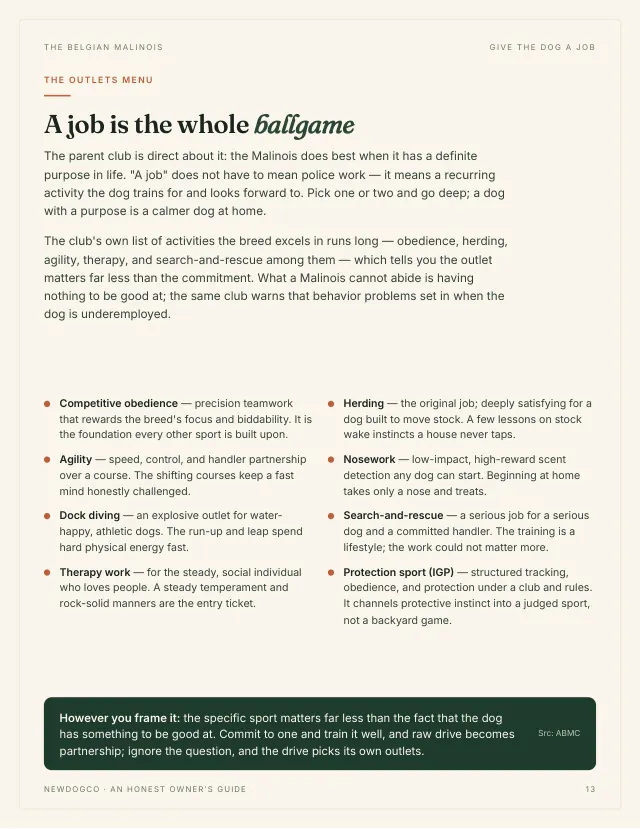
The breed needs a job. Structured outlets like protection sport, scentwork, herding, agility, dock diving, or advanced obedience give the drive somewhere productive to go. Rotate activities so training stays fresh and the dog stays engaged.
- Long, purposeful exercise: running, fetch with rules, biking alongside, structured play
- Daily mental work: obedience reps, scent games, puzzle feeders, shaping new behaviors
- A real outlet several times a week: a sport, a class, or a working task
- Calm settle training so an on switch also has an off switch
Skip these and the energy comes out as destruction. It is a common reason Malinois end up rehomed.
Grooming and coat
Grooming is one of the easy parts of Malinois ownership. The breed wears a short, straight double coat that is weather-resistant and low maintenance. A weekly brush keeps it healthy most of the year, with more frequent brushing during seasonal shedding when the undercoat blows.
Expect steady shedding overall and heavier sheds a couple of times a year. A rubber curry or short-bristle brush pulls loose hair efficiently. Bathe only occasionally, when the dog is visibly dirty, so you do not strip the coat's natural oils.
Round out grooming with the basics every dog needs: keep nails trimmed so they do not click or splay the toes, check and clean ears, and build a tooth-brushing habit early. Because the Malinois is so active, make a routine of checking paw pads, legs, and skin after hard work or fieldwork for cuts, foxtails, or ticks. A short coat makes those checks quick, which is one more reason this breed is simple to keep clean.
Belgian Malinois health: what to watch for
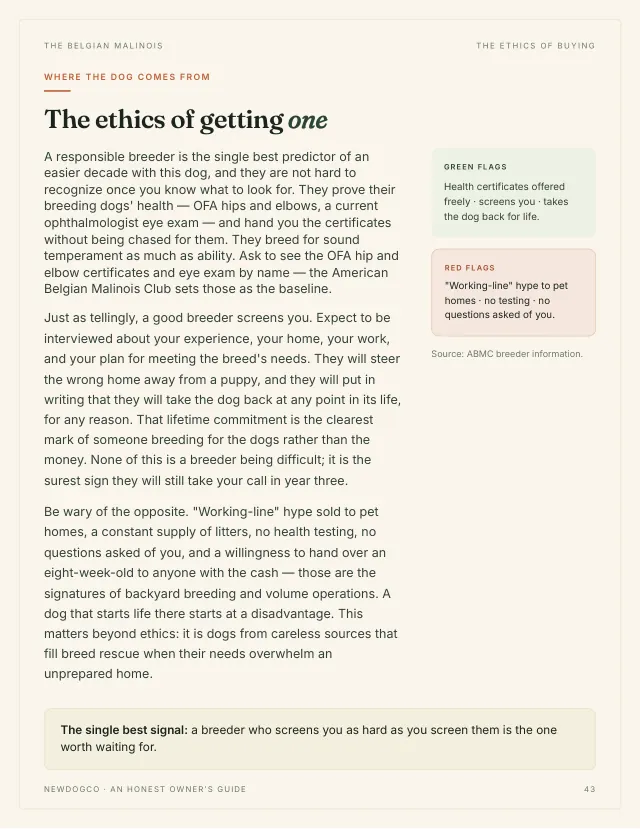
This is generally a sound, athletic breed, but responsible ownership means knowing its risks and screening for them. Always work with a veterinarian, and choose breeders who health-test their dogs.
- Hip and elbow dysplasia: joint conditions the Orthopedic Foundation for Animals (OFA) evaluates through radiographic screening in breeding dogs.
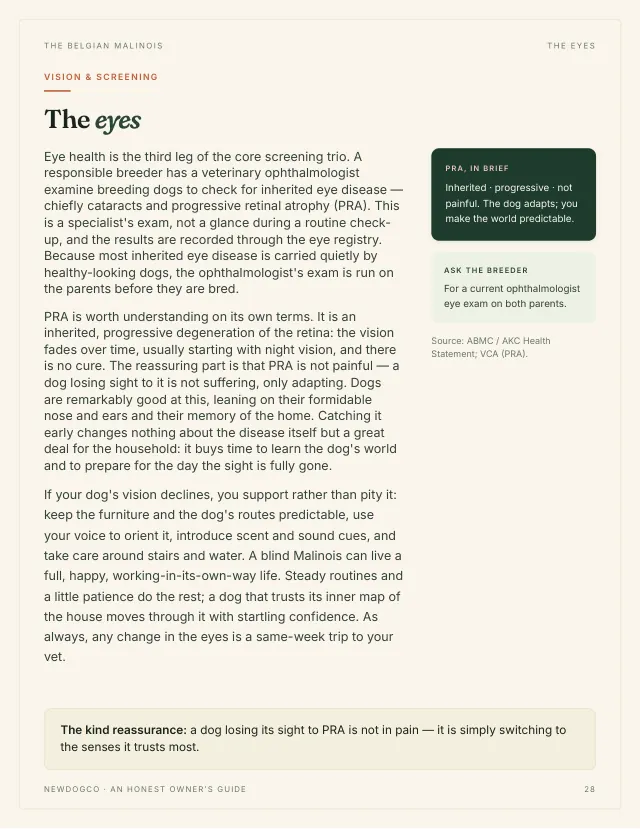
- Progressive retinal atrophy (PRA): an inherited degenerative eye disease; eye screening and, where available, genetic testing are recommended by veterinary ophthalmology sources.
- Epilepsy: seizure disorders are recognized in the breed; the American College of Veterinary Internal Medicine (ACVIM) publishes guidance on canine seizure workup and management.
- Anesthesia sensitivity: like other lean, high-drive working breeds, individuals can be sensitive to anesthesia, so discuss protocols with your veterinarian before any procedure.
Follow AAHA-aligned preventive care: regular exams, vaccines, parasite prevention, and dental care. Feed to keep this athletic dog lean, and report any seizure activity, lameness, or vision changes to your veterinarian promptly. These are risks to monitor, not certainties.
Training this breed
Training is not optional with a Belgian Malinois; it is how you live with one. The good news is that this breed is brilliant, eager, and learns fast. That intelligence cuts both ways: a Malinois learns bad habits just as quickly as good ones, so start early and stay consistent.
Use reward-based, force-free methods only. Food, toys, play, and access to the things the dog wants are powerful with a breed this driven. Harsh, dominance-based, or aversive tools are unnecessary and can backfire badly on a sensitive, high-arousal dog, damaging trust and increasing reactivity.
Prioritize impulse control, focus under distraction, a rock-solid recall, and a reliable off switch. Keep sessions short, upbeat, and frequent. The included 20-command training book walks you through foundation obedience and control step by step. Because the Malinois thrives on partnership, an experienced, committed handler, or a good reward-based trainer or class, makes the difference between a controlled working dog and an overwhelmed one.
Living with a working breed at home
A Belgian Malinois brings working-dog intensity into your living room whether or not you have a farm or a sport field. That reality shapes everyday life. This breed is deeply loyal and often naturally watchful, which means early, ongoing socialization is essential so alertness does not tip into suspicion or reactivity toward strangers, dogs, or noise.
Their drive to chase and control movement is strong. Small running animals, bikes, skateboards, and even children at play can trigger herding or chase behavior, so management and training around motion matter. Secure fencing is a must; a bored Malinois is an escape artist.
They form intense bonds and generally want to be with their person, which makes them poor candidates for long hours of isolation. Build independence and settle skills early to prevent separation distress. Give this dog structure, a job, and daily engagement, and you get a devoted, focused partner. Give it a vacuum of boredom, and it will invent its own job, usually one you will not like.