
What leash reactivity actually is
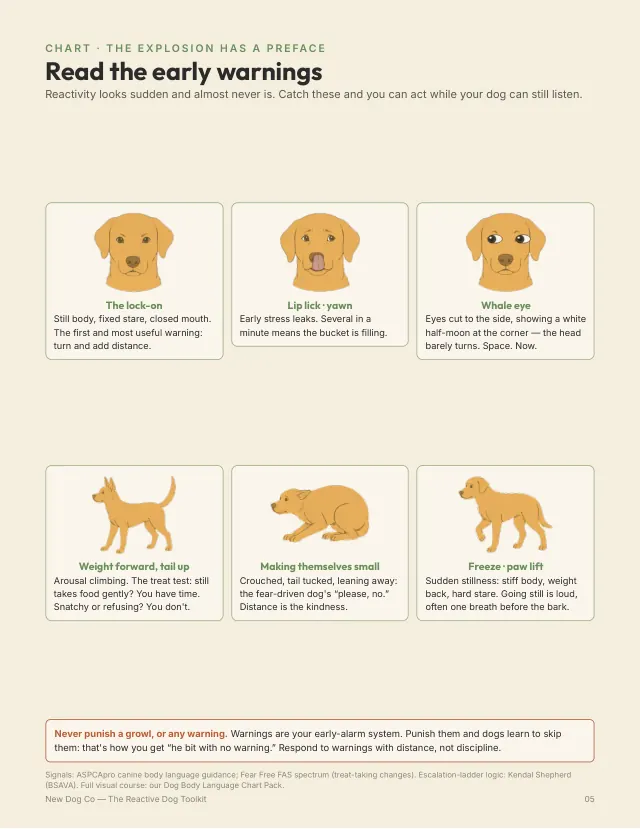
Reactivity is an emotional reaction, not defiance. When a dog barks, lunges, or freezes at another dog, a person, or a bike, it is almost always driven by fear, frustration, or over-arousal, not dominance or a wish to control the walk. The ASPCA and veterinary behavior resources describe leash reactivity as a stress response: the trigger appears, the dog feels it cannot create distance or reach what it wants, and the loud display is what remains.
This matters because the old alpha framing leads to corrections that make fear worse. The American Veterinary Society of Animal Behavior (AVSAB) holds that reward-based methods should be the standard, and that aversive tools — prong collars, shock, leash pops, and physical intimidation — raise the risk of fear, anxiety, and aggression. A reactive dog is already over threshold; adding pain or a startle only stacks more stress onto the same trigger.
The aim of this toolkit is to change how your dog feels about the trigger, so the outburst no longer has a job to do. That work starts with knowing what sets your dog off, and at what distance.
Threshold: why distance is your main tool
Distance is your most powerful tool. Every reactive dog has a threshold: the point at which a trigger becomes too close or too intense and the dog tips from noticing into reacting. Under threshold, your dog can see the other dog or bike, take a treat, and respond to you. Over threshold, the thinking brain goes offline and no cue will land.
The whole plan depends on keeping your dog under that line as often as possible. If a jogger at forty feet is fine but twenty feet is too much, you work at forty and slowly close the gap over many sessions. Crossing the street, stepping behind a parked car, or turning away are not failures; they are how you protect the threshold.
Trigger stacking makes this harder: several stressors in a short window — a garbage truck, then a barking dog, then a skateboard — pile up, and a dog that coped at breakfast may erupt an hour later at something small. The threshold worksheet helps you find each trigger's working distance and notice when the day has already used up your dog's reserve.
Force-free methods that change the emotion
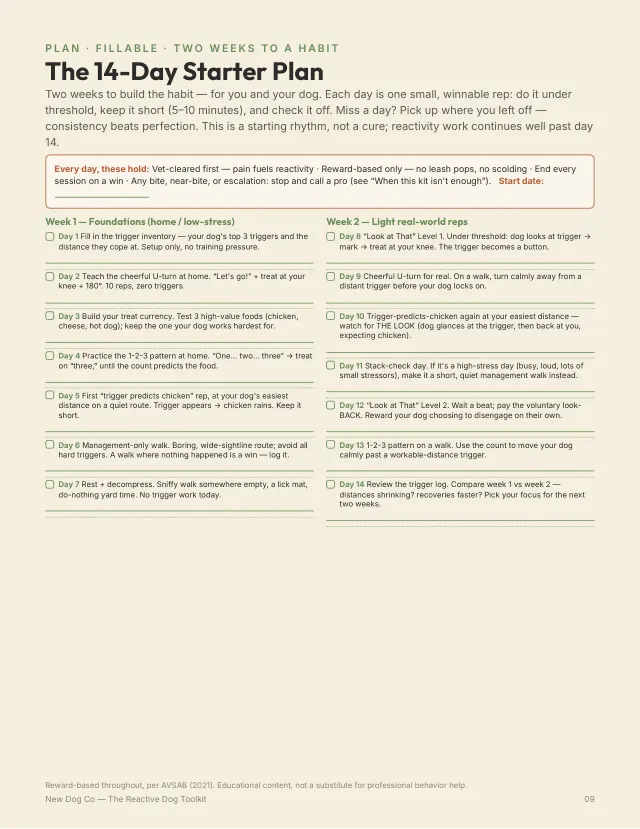
Counter-conditioning changes the underlying feeling. The core force-free method for reactivity is desensitization paired with counter-conditioning: expose the dog to the trigger at a low enough intensity that it stays calm, then pair that sight with something excellent, usually high-value food. Done consistently, the trigger starts to predict good things, and the emotional response shifts from alarm toward "that thing means chicken appears." This is the standard approach described in veterinary behavior literature and supported by AVSAB's stance on reward-based training.
Layered on top is engage-disengage, often taught as the "Look at That" game from Leslie McDevitt's Control Unleashed: you mark the moment your dog calmly notices the trigger, then reward, so looking and turning back to you becomes a rehearsed, relaxed pattern. Over time the dog offers the check-in on its own.
Both methods share one rule: your dog must stay under threshold for learning to happen. Flooding (forcing a fearful dog to face triggers up close until it "gets over it") is discouraged by behavior professionals because it usually deepens fear. The fill-in plans let you script both games for your dog's specific triggers and distances.
Management so your dog stops rehearsing
Management keeps your dog from rehearsing the outburst. Every time a dog goes over threshold and barks or lunges, that pathway gets a little more practiced. Good management keeps those reps from happening while training builds new habits.
Start with equipment: a well-fitted front-clip harness gives you steadier control without the coughing and neck pressure a collar puts on a lunging dog, and it never relies on pain. Choose a fixed-length leash over a retractable so distance is predictable. At home, visual barriers (window film, a lowered blind, an ex-pen) cut off the fence-line and window rehearsals that fuel reactivity.
On walks, plan routes and timing so you control the distance: quieter streets, wider sightlines, off-peak hours, and an escape route in mind for every stretch. Keep the trigger at a distance your dog can handle rather than hoping it works out. Management is not giving up or "letting the dog win": the ASPCA frames it as setting the environment up so the dog can succeed. Fewer over-threshold moments mean faster, more durable progress from the training you do.
Using the trigger log and trackers
Written logs turn guesswork into a plan. Reactivity progress is uneven, and memory is unreliable: a bad Tuesday can convince you nothing is working when the trend is actually up. Logging every outing gives you real data.
The trigger log asks for the date, the trigger, the distance, your dog's reaction on a simple scale, and what happened just before. Over a couple of weeks, patterns surface: maybe your dog handles other dogs fine but not bikes, or does well in the morning but not after a stressful vet day. That tells you exactly where to set distances and which triggers need the most work.
The weekly trackers log calm repetitions, threshold distances that are shrinking, and setbacks without judgment. A setback is information, not failure: it often signals trigger stacking or a distance closed too quickly. Bring these pages to any trainer or veterinary behaviorist you consult; a clear history of triggers, distances, and reactions makes their assessment far faster and more accurate.
When to involve a veterinary behaviorist
Some reactive dogs need a veterinary behaviorist. Training helps most reactive dogs, but not all reactivity is purely learned, and not every case is safe to work alone. A board-certified veterinary behaviorist (DACVB, a veterinarian with specialty training through the American College of Veterinary Behaviorists) can diagnose underlying fear or anxiety disorders, rule out or treat pain that lowers a dog's tolerance, and, when appropriate, add anti-anxiety medication to a behavior plan.
Consider a referral if your dog has bitten and broken skin, if reactivity is escalating despite consistent force-free work, if your dog cannot stay under threshold on any reasonable walk, or if the fear looks severe enough that the dog cannot eat or settle. Sudden new reactivity in a previously calm dog also warrants a veterinary exam, since pain and medical conditions can drive behavior change.
Medication is not a shortcut or a sedative crutch; when a veterinarian prescribes it, the goal is to lower the fear enough that learning can happen. This toolkit supports professional guidance and your own training, but it does not replace a veterinary exam or a diagnosis.