Is It Really Separation Anxiety?
Not every dog that misbehaves alone has separation anxiety. The ASPCA describes separation anxiety as real distress and panic that appears when a dog is separated from the people it is attached to. It is different from two other things this toolkit helps you tell apart.
Boredom looks like chewing, digging, or getting into the trash, but the dog is calm, not panicked, and often does the same things when you are home. Isolation distress is upset at being alone regardless of who leaves; the company of any person, or sometimes another dog, settles the dog. True separation anxiety is attachment to specific people, with signs that start as you prepare to go and peak soon after you leave.
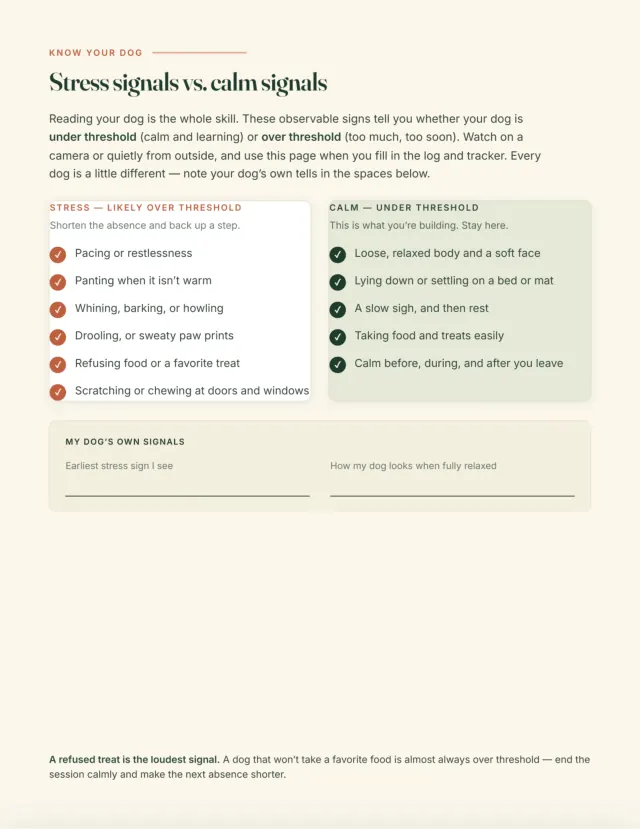
Common signs of the anxious pattern include persistent barking or howling, pacing, drooling, house-soiling in a house-trained dog, and destruction focused on exits. The symptom log inside lets you record these with video so you and your veterinarian can reach an accurate picture rather than guessing.
Graduated Departures, Done Properly
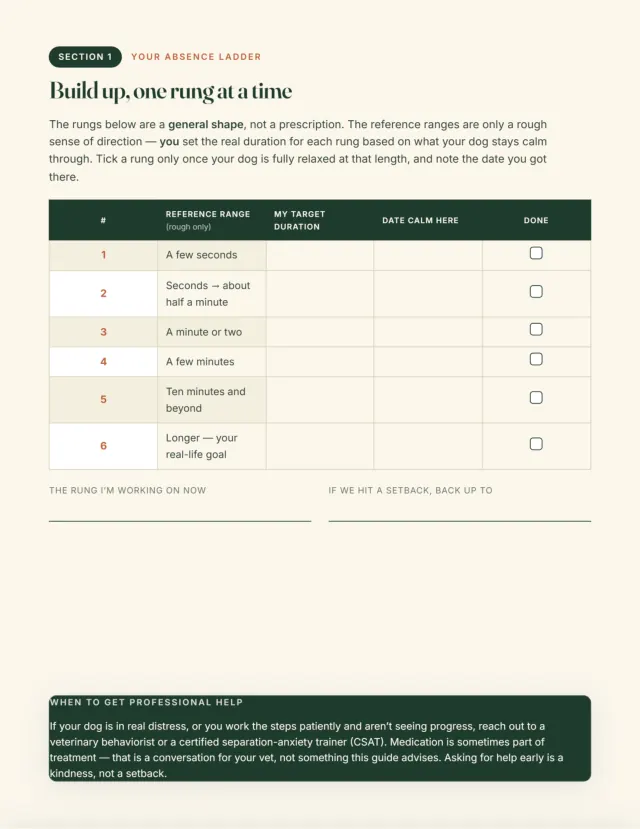
The evidence-based approach to separation anxiety is systematic desensitization: exposing your dog to being alone in doses so small they never trigger panic, then increasing the duration gradually. The ASPCA emphasizes that the whole method depends on staying below the threshold where fear begins.
Start by finding how long your dog stays relaxed. For many anxious dogs that is seconds, not minutes. You practice stepping out and returning before any stress appears, keeping departures and arrivals calm and low-key. Only when your dog is comfortable at one duration do you add a little more time, and progress is rarely linear, so the worksheet gives you room to repeat and step back.
This is slow work measured in weeks, not days. Rushing ahead and letting your dog rehearse panic sets progress back, because each full-blown panic episode reinforces the fear. The graduated-absence pages help you plan sessions, log your dog's body language, and only advance when the previous step feels easy to your dog, which is how lasting change is built.
What Not to Do
Some common responses make separation anxiety worse. Punishing a dog for barking, house-soiling, or destruction after the fact does not teach it to be calm; the behaviors are products of panic, not defiance, and the American Veterinary Society of Animal Behavior warns that aversive methods increase fear and anxiety. Punishment adds a new fear to an already frightened dog.
Flooding is the opposite mistake to graduated departures: leaving an anxious dog alone for long stretches in the hope it will get used to it. This forces the dog to stay in full panic and typically deepens the problem. Forcing a crate on a dog that panics in confinement is also harmful; some dogs injure themselves trying to escape a crate, so confinement is never a fix for the anxiety itself.
Avoid dramatic, drawn-out goodbyes and reunions, which raise the emotional stakes around your leaving. The toolkit keeps you on a reward-based path built on lowering fear, and flags these traps so you do not accidentally rehearse the very panic you are trying to resolve.
Enrichment and a Safe Space
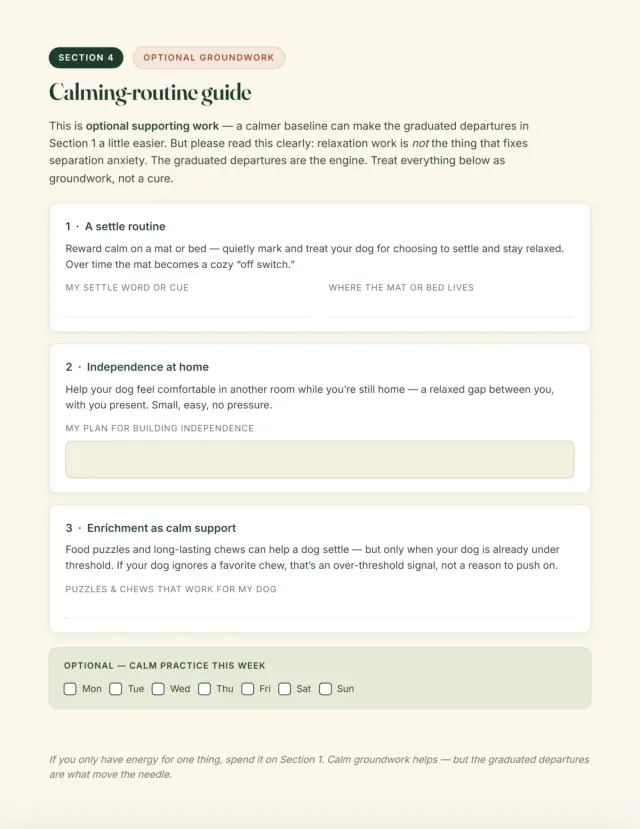
A dog whose needs are met copes better with alone time. Daily physical exercise and mental enrichment lower baseline arousal, so the enrichment checklist inside builds in sniffing walks, chewing, food puzzles, and short training games. Enrichment is a support for the desensitization plan, not a cure on its own, but it makes the harder work more achievable.
A safe space is a calm resting area your dog associates with good things and chooses freely. For some dogs that is an open crate with the door secured back, a bed in a quiet room, or a corner away from the front door and windows. The key word is choice: a safe space works because the dog wants to be there, which is the opposite of forced confinement.
Long-lasting chews or a food-stuffed toy can help build a positive association with your departures, but only once your dog is calm enough to eat, since a panicking dog will ignore food. The setup page walks you through arranging the space and recording what actually settles your individual dog.
When Medication Belongs in the Plan
For many dogs, medication is a legitimate and sometimes essential part of treating separation anxiety, not a last resort or a sign of failure. Anxiety is a physiological state, and a brain flooded with fear cannot learn. The ASPCA notes that for moderate to severe cases, behavior modification combined with anti-anxiety medication is often the most effective approach.
Medication is prescribed only by a veterinarian, and complex cases are well served by a board-certified veterinary behaviorist (DACVB). Some medications are specifically approved for canine separation anxiety; per the Merck Veterinary Manual, clomipramine and fluoxetine carry that veterinary approval, always alongside a behavior plan. Your veterinarian decides whether medication is appropriate, which one, and at what dose, based on your dog's health and history.
Never give a dog human anxiety medication or another pet's prescription; doses and safety differ, and some human drugs are toxic to dogs. The vet-prep sheet in this toolkit helps you organize video, a symptom timeline, and questions so that conversation is productive, and so medication, if used, sits inside a complete, force-free plan.
How This Toolkit Fits Your Plan
Separation anxiety improves with structure, honest records, and patience, and this toolkit is built to give you all three. It is a working document rather than a book to read once. You log behavior, plan graduated sessions, track what helps, and carry organized evidence into every professional conversation.
Because separation anxiety can overlap with medical issues and with other fears, a veterinarian's involvement matters from the start. Use the pages to gather the video and timeline your vet needs, and treat any diagnosis or medication decision as theirs to make. If progress stalls, or if your dog is injuring itself or panicking severely, that is a signal to escalate to your veterinarian or a veterinary behaviorist rather than pushing harder alone.
Everything here follows reward-based, force-free principles endorsed by the AVSAB: you are lowering fear, not suppressing behavior. Worked consistently and in partnership with your vet, this plan gives an anxious dog the gradual, predictable experience of learning that being alone is safe, which is the outcome that actually lasts.