Does My Dog Hate Its Halloween Costume? How to Tell (and What to Do)
Some dogs don't mind dressing up, and some are quietly miserable. The difference is written all over your dog, and you can learn to read it.
On this page
Watch your dog for the first thirty seconds after the costume goes on. If she freezes in place, licks her lips, yawns when she isn’t tired, shows the whites of her eyes, pins her ears back, shakes off the instant the costume comes near, or simply refuses to walk, she’s telling you, clearly and in fluent dog, that the costume is stressing her out. Some dogs don’t mind dressing up at all; plenty of relaxed, food-motivated dogs will trot around in a hot-dog suit all evening with a loose, wiggly body. But many dogs are quietly miserable in costume, and because they can’t say so in words, they say it with their bodies. The good news: the signals are easy to read once you know them, a gentle desensitization plan can win some dogs over, and for the rest, a festive bandana — or nothing at all — is a perfectly good Halloween.
The signals: how a dog says “get this off me”
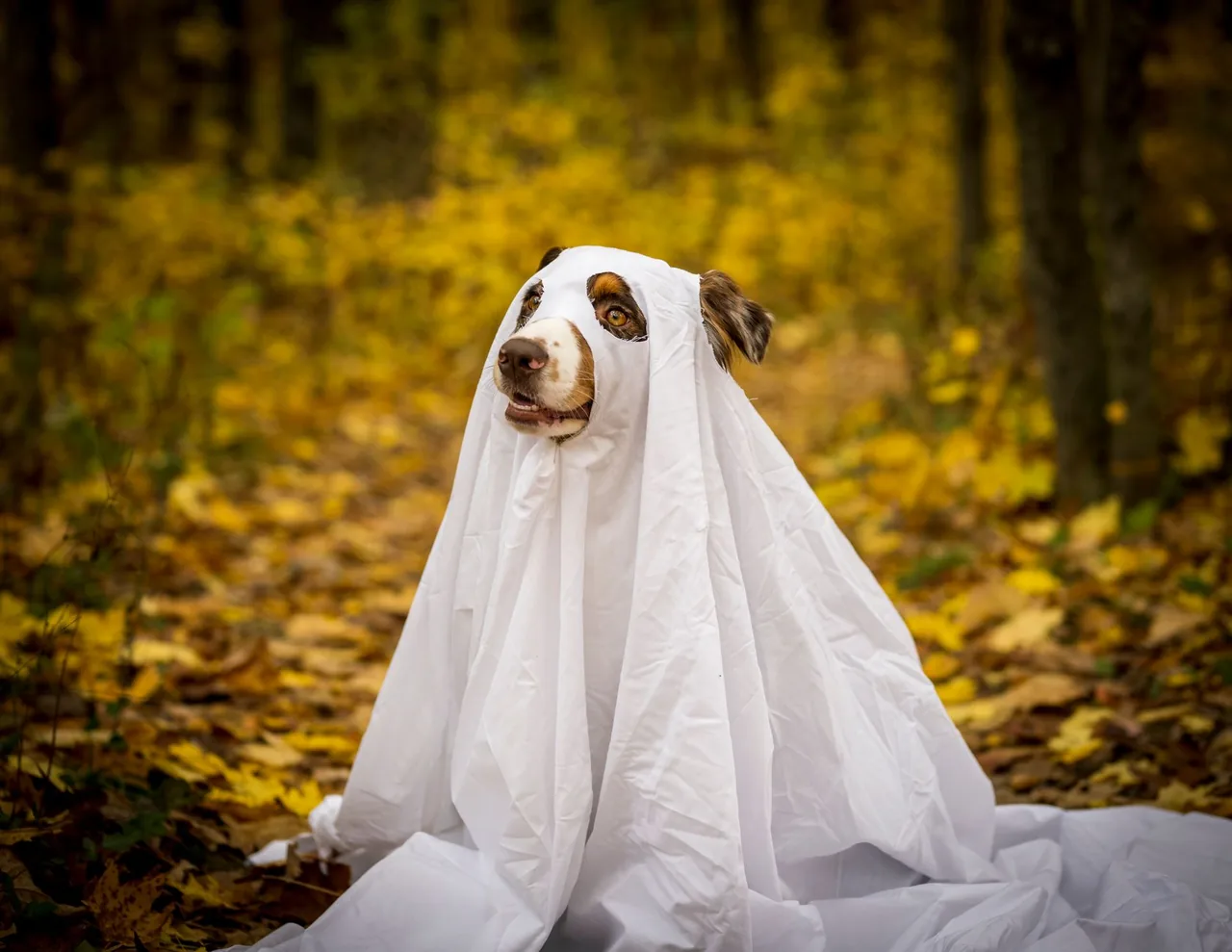
Dogs under mild stress use a well-documented set of signals, often called calming or stress signals, long before they escalate to anything dramatic. In a costume context, watch for:
- Freezing. The most common and most misread one. A dog who stands stock-still in a costume isn’t “posing nicely.” She’s shut down. Movement is how dogs communicate; a frozen dog is a worried dog.
- Lip-licking and yawning outside of mealtime or bedtime. Quick tongue flicks and out-of-context yawns are classic low-level stress signals.
- Whale eye. The head turns away but the eyes stay on you, showing a crescent of white. It signals discomfort with what’s happening.
- Flattened ears and a lowered tail. Ears pinned back against the skull and a tail carried low or tucked say the dog wants out of the situation.
- Shaking off — that full-body wet-dog shake when she isn’t wet — right after you remove the costume, or repeatedly while wearing it. It’s a reset button dogs press after something unpleasant.
- Refusing to move, walking in a stiff, exaggerated gait, or repeatedly pawing and biting at the fabric.
One signal on its own is a word; a cluster is a sentence. A single lip-lick while you fasten a strap means little. Freezing plus whale eye plus pinned ears means “I hate this.” Believe it the first time. If you want to get properly fluent in these signals (they matter far beyond Halloween), run what you’re seeing through the free Dog Body-Language Decoder. It walks you through reading whole clusters instead of single signs, which is exactly the skill this decision needs.
Why a costume feels so different to a dog than to you
To us, a costume is fabric. To a dog, it’s three problems at once. It creates unfamiliar pressure and texture across the back, chest, and legs — sensations most dogs have never been taught to accept. It restricts movement, and dogs communicate with movement, so a costume can literally muffle her ability to “speak” to other dogs, which is one reason costumed dogs sometimes get odd reactions at the park. And pieces that sit near the head — hats, hoods, wigs, masks — interfere with vision and hearing, the senses a dog relies on to feel safe. None of this means costumes are cruel. It means a costume is a real ask, and some dogs will say no.
If your dog seems fine, check anyway
A dog who’s fine in a costume looks like herself: loose, curvy body, normal tail carriage, ears in their usual position, walking freely, taking treats easily, maybe wagging at the attention. Do a quick read before you commit to an evening — put the costume on, drop a few treats on the floor, and watch. A comfortable dog eats, sniffs, and moves on. A stressed dog freezes, refuses food she’d normally inhale, or does the stiff-legged robot walk. Refusing favorite treats is one of the most reliable stress tells there is.
Winning a dog over: desensitization, not endurance
If your dog is somewhere in the middle — not panicked, not thrilled — you can often change her mind with a few short sessions spread over the days before Halloween. The principle is simple: the costume should predict good things, in doses so small she never gets worried.
Start with the costume lying on the floor while treats rain down near it; let her sniff it and get paid for optional curiosity. Once she’s relaxed about its existence, drape it loosely over her back for literally two or three seconds while she licks something delicious, then take it off before she cares. Seconds first, always — duration is the last thing you build, not the first. Over several sessions, work up to fastening it, then to wearing it briefly while good things happen, watching her body the whole time. If stress signals show up, you’ve gone too fast; make the next rep shorter and easier. Never scold a dog for resisting a costume, and never pin her down to force it on. The American Veterinary Society of Animal Behavior is clear that force and punishment add fear rather than removing it, and a dog wrestled into a costume this year will be harder to dress next year.
Costume safety, even for the happy dressers
For the dogs who enjoy it, a few non-negotiables from ASPCA guidance: the costume must not restrict movement, vision, hearing, breathing, or the ability to bark, drink, and relieve herself. Skip anything with small, dangling, or easily chewed-off parts — buttons, bells, pom-poms — which are choking and blockage hazards. Check the fit: you should get two fingers under any strap, with no rubbing at the armpits or neck. Try the full costume on before the big night, and never leave a costumed dog unsupervised, even for a minute. Fabric plus an unattended dog is how emergency vet visits start.
The dignified alternatives
If your dog votes no, she isn’t failing Halloween. A festive bandana over her regular collar gives you the photo without the full costume, and most dogs barely notice one. An orange collar or leash, a pumpkin-print harness strap, a seasonal tag: all costume energy, zero costume stress. And “nothing at all” is a complete answer. Your dog does not know it’s Halloween. She will not feel left out.
When to skip it entirely
Some dogs shouldn’t be asked at all: dogs who are already fearful or anxious, seniors with arthritis who can’t comfortably be handled into clothing, dogs who panicked in past attempts, and any dog who’ll already be coping with a hard evening of doorbells and costumed strangers. If that’s your house, your energy is better spent on a calm plan for trick-or-treat night than on a costume. Halloween lasts one evening. Your dog’s trust in you is supposed to last her whole life. When in doubt, take the bandana and the win.
Frequently asked questions
- How do I know if my dog hates wearing a costume?
- Look for a cluster of stress signals in the first minute after the costume goes on: freezing in place, lip-licking, yawning when she isn't tired, whale eye (whites of the eyes showing as the head turns away), flattened ears, a low or tucked tail, a stiff exaggerated walk, or refusing to move at all. A full-body shake-off the moment the costume comes off is another clear review. The most reliable single tell is food refusal; a dog who turns down treats she normally loves is over her stress threshold. One signal alone can be ambiguous, but two or three together are a clear no. A comfortable dog, by contrast, stays loose and wiggly, walks normally, takes treats easily, and generally acts like herself with fabric on.
- Is it cruel to put a costume on a dog?
- Not inherently. It depends entirely on the individual dog and on how you got there. Some relaxed, well-socialized dogs are completely unbothered by costumes, especially when the costume has been introduced gradually and paired with treats, fits well, and doesn't restrict movement, vision, hearing, or breathing. For those dogs, an evening in costume is a non-event. What crosses the line is forcing it: pinning a dog down to dress her, ignoring clear stress signals like freezing and whale eye, or leaving an unhappy dog in a costume for hours. Veterinary behavior organizations like AVSAB are clear that adding fear and force to handling damages trust and makes future handling harder. If your dog says no, a festive bandana delivers the holiday spirit at zero cost to her.
- How do I get my dog used to a Halloween costume?
- Gradually, over days, with the costume predicting treats and sessions measured in seconds. Start with the costume on the floor while you scatter treats nearby, so sniffing it pays. Next, drape it loosely over her back for two or three seconds while she licks something delicious, and remove it before she worries. Over several short sessions, progress to fastening it, then to brief wearing, always ending while she's still relaxed. Duration comes last, never first. Watch her body language throughout: lip-licking, freezing, or food refusal means you've moved too fast, so make the next repetition shorter and easier. Never scold resistance or force the costume on — that teaches her the costume predicts conflict. Many dogs in the "meh" middle ground come around after a week or so of two-minute sessions.
- Why does my dog freeze when I put clothes on him?
- Freezing is one of the most misunderstood dog behaviors. Owners often read a motionless dog as calm or even cooperative — "he just stands there, he's fine with it" — but stillness under novel pressure is usually the opposite of fine. Freezing is a conflict response: the dog is uncomfortable, unsure how to escape the sensation, and shuts movement down. Clothing creates unfamiliar pressure and texture across the back and chest, and it muffles the body movements dogs use to communicate, which many find unsettling. The test is what happens around the freeze: will he walk normally, take treats, and wag? Then he may just be adjusting. If he stays statue-still, refuses food, and shakes off dramatically when the clothes come off, he's telling you he hates it. Believe him.
Educational content only — not veterinary or professional behavior advice. Consult your vet, or a certified trainer or behaviorist, for your pet. Read the full disclaimer →