Shy Cat Trust-Building Log
How do you help a scared rescue cat feel safe? Start in one small, quiet room with places to hide, let the cat come out in its own time, and let it start every contact. International Cat Care, the ASPCA and the AAFP/ISFM cat-handling guidelines all describe the same patient approach, and the 3-3-3 rule (three days, three weeks, three months) is a rough guide to the timeline. This one-page log gives you the safe-room checklist, the trust-building steps, and a daily record of eating, litter use and how close your cat came.
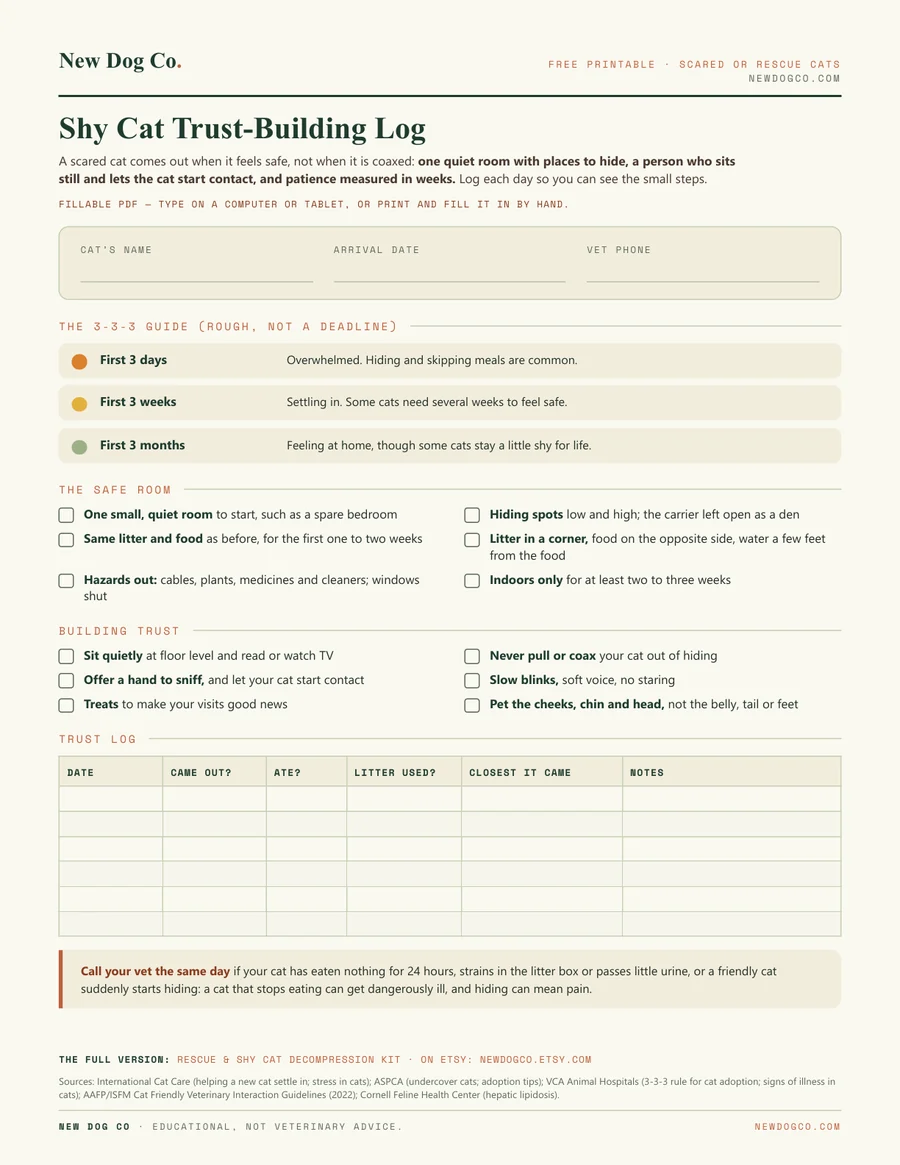
Fillable · bilingual EN/ES · vet-sourced, not a scanned template.
 Got the free sheet? The full version → Rescue & Shy Cat Decompression Kit
What's inside
- The 3-3-3 guide: what the first three days, three weeks and three months often look like
- A six-point safe-room checklist, from hiding spots to keeping the old litter and food
- Six ways to build trust without coaxing, including slow blinks and where to pet
- A fillable daily log: came out, ate, used the litter, closest approach, notes
- The signs that need the vet the same day
How to use it
- Set up the safe room before your cat comes home, and tick each item off.
- Spend quiet time in the room every day without reaching for your cat.
- Log eating, litter use and how close your cat came, so you can see the small steps.
- Call your vet the same day if your cat stops eating for 24 hours or strains in the litter box.
Sources
Vet-sourced: the facts on this sheet come from these sources. It is educational, not veterinary advice.
- International Cat Care (helping a new cat settle in; stress in cats)
- ASPCA (undercover cats; adoption tips)
- VCA Animal Hospitals (3-3-3 rule for cat adoption; signs of illness in cats)
- AAFP/ISFM Cat Friendly Veterinary Interaction Guidelines (2022)
- Cornell Feline Health Center (hepatic lipidosis)
Published
New printables + calm, sourced dog-care tips
Join the Pack and the 25-printable bundle is your instant thank-you — then we email new printables and short, vet-sourced tips as they’re ready. A few times a month, no spam.
The 25-printable pack lands instantly — new printables and tips follow. Unsubscribe anytime. Privacy Policy.Frequently asked questions
- How long does it take a scared rescue cat to adjust?
- It varies a lot. The 3-3-3 rule used by VCA and the ASPCA is a rough guide: about three days feeling overwhelmed, three weeks settling in and three months feeling at home. International Cat Care notes that some cats need several weeks to feel safe, and the ASPCA says some stay a little shy for life.
- Should I pull my cat out from under the bed?
- No. Hiding is a normal way for a cat to cope, according to the AAFP/ISFM cat-handling guidelines, and International Cat Care advises against pulling or coaxing a hiding cat out. Make sure there is always somewhere to hide, and let your cat come out in its own time.
- How do I get a scared cat to trust me?
- Sit quietly at floor level, offer a hand to sniff and let the cat start contact. Speak softly, avoid staring, and try slow blinks: in a 2020 study, cats were more likely to approach an unfamiliar person after slow blinks than after a neutral face. Treats help make your visits good news.
- Do pheromone diffusers help a scared cat?
- The evidence is mixed. A 2017 trial with 336 shelter cats found no effect on stress scores, while a 2023 review found moderate evidence that a facial pheromone may reduce short-term stress at the vet. They may help some cats, but never as the only step.
- How can I tell if my cat is scared?
- Freezing, crouching, a tucked tail, flattened ears, wide pupils, hissing or trying to escape, according to International Cat Care. A very frightened cat may simply freeze with half-closed eyes, which is easy to mistake for calm.
- When is hiding a medical problem?
- When a normally friendly cat suddenly starts hiding, it may be in pain or ill. A cat that has eaten nothing for 24 hours, strains in the litter box or passes little urine needs a vet right away, because a cat that stops eating can become seriously ill.
Free educational printable. Not veterinary advice, and not a substitute for your vet's official records or an emergency call. Full disclaimer → · Leer en español →