How house-training actually works
House-training is not about willpower or scolding. It is about arranging the day so your puppy succeeds and then rewarding the outcome you want. Three things do the work together.
- Supervision so you are present at the moment of elimination and can reward it, and so you can interrupt gently and redirect if your puppy starts to go indoors.
- A consistent schedule so the bladder and bowels empty on a predictable routine rather than at random.
- An immediate reward delivered the instant your puppy finishes in the correct spot, so the act and the reward are clearly linked.
The American Society for the Prevention of Cruelty to Animals (ASPCA) describes this management-first, reward-based approach as the reliable path to a house-trained dog, and the American Veterinary Society of Animal Behavior (AVSAB) supports reinforcement-based training over punishment across behavior goals. The log and schedule in this program exist to make all three parts easy to keep consistent, because consistency, not intensity, is what teaches the habit.
Why you never punish accidents
Punishing a puppy for an accident, after the fact or in the moment, does not teach them where to go. It teaches them that eliminating in front of you is dangerous. The common result is a dog who learns to sneak behind the couch or hold it until you are not looking, which makes house-training harder, not easier. The ASPCA is explicit that rubbing a dog's nose in a mess, scolding, or any punishment for accidents is counterproductive and can increase fear and hiding.
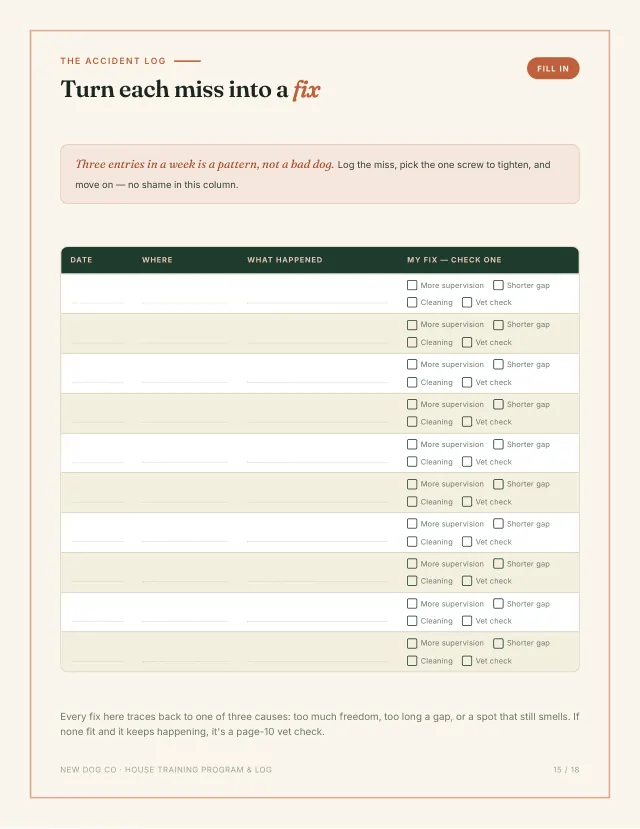
Treat an accident as a missed trip outside, not a crime. If your puppy has one, it usually means a trip was missed, the schedule was too spread out, or supervision lapsed. Interrupt calmly if you catch them starting, take them to the right spot, and reward if they finish there. Then clean the area thoroughly and adjust the schedule. This program's log is designed to capture what preceded each accident so you can fix the routine rather than blame the dog.
Using a crate or confinement correctly
A crate works because most dogs will avoid soiling the space where they rest, which helps a puppy learn to hold it for short, appropriate stretches. That only holds if the crate is sized correctly: big enough to stand up, turn around, and lie down comfortably, but not so large that your puppy can eliminate in one corner and sleep in another. For a growing puppy, a crate with a divider that moves as they grow keeps the space right.
The crate must be a positive place, introduced with treats, meals, and calm, never used as punishment. Confinement time has to match what your puppy can physically manage; a crate is not a substitute for taking them out on schedule. When you cannot supervise, a small puppy-proofed pen or a short crate stretch prevents unsupervised accidents that would otherwise set training back. If your puppy is soiling the crate despite correct sizing, treat that as a signal to shorten the interval or check with your veterinarian rather than to confine longer.
A realistic potty schedule by age
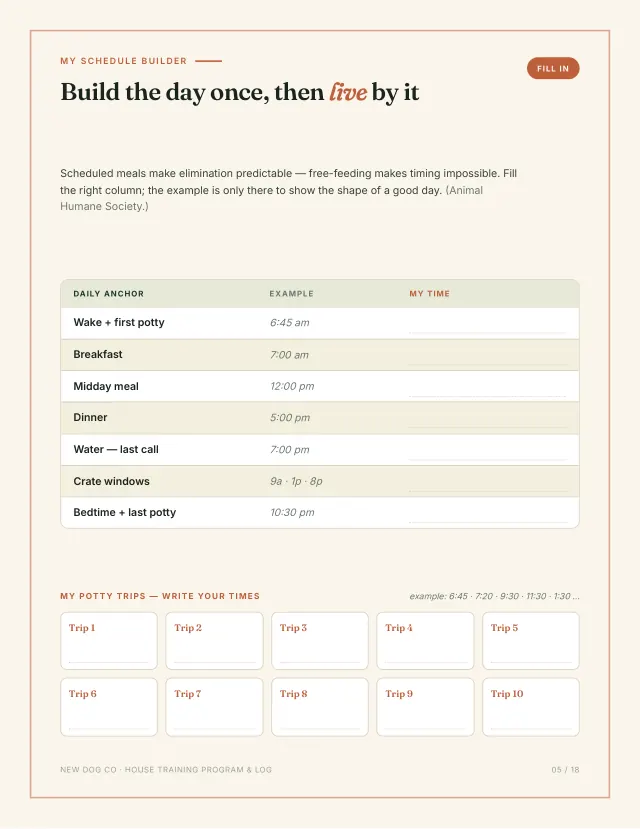
Young puppies have small bladders and limited control, so the schedule matters more than anything. A widely used veterinary and training rule of thumb is that a puppy can hold its bladder for roughly one hour per month of age, plus one, so a two-month-old puppy may manage about three hours during the day at most. This is a general guideline for planning, not a target to push toward; going out more often than the maximum is always fine and usually helpful.
Beyond the clock, certain moments almost guarantee a full bladder: after waking, after eating, after drinking, and after play. Build a trip around each of those. Very young puppies typically need an overnight trip as well, and that need shrinks as they mature. The age-based template in this program lets you set your own outing times and then correct them against what your log shows, because every dog's real capacity varies. Steady, frequent, predictable trips prevent the accidents that slow everything down.
Cleaning accidents so they don't recur
Where an accident happens matters, because urine leaves an odor cue that draws a dog back to the same spot. Ordinary household and ammonia-based cleaners can mask the smell to a human nose while leaving the scent markers a dog detects. The ASPCA recommends cleaning accidents with an enzymatic cleaner made for pet messes, which breaks down the compounds in urine rather than just covering them.
The routine is simple: blot up as much liquid as you can first, then apply the enzymatic cleaner generously enough to reach everywhere the urine soaked, and let it work for the time on the label rather than wiping it off immediately. Avoid steam cleaners and ammonia products on the area, since heat can set stains and ammonia can smell like urine to your dog. This program's cleanup checklist keeps the steps in order so a repeat accident in the same corner does not become a habit you are unknowingly reinforcing.
Regression, marking, and reading your log
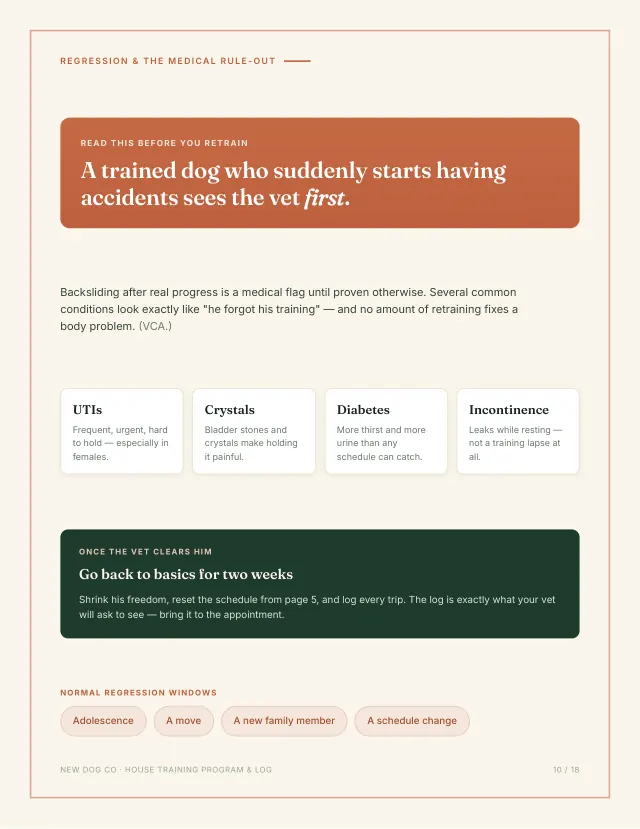
A puppy who was doing well and suddenly starts having accidents is showing you something. The first step is to rule out a medical cause: urinary tract infections, gastrointestinal upset, and other conditions cause sudden accidents, and the ASPCA advises checking with your veterinarian before treating a relapse as a training problem. Once health is cleared, look at what changed: a schedule that stretched too far, a move, a new person or pet, or a stressful event can all trigger regression, which usually resolves by returning to frequent trips and rewards.
Marking is different from a house-training gap: it is small amounts on vertical surfaces, often tied to social or territorial triggers rather than a full bladder. It can occur in dogs of either sex and is addressed with management and reinforcement, not punishment. Your daily log is the tool that makes all of this legible — patterns in timing, location, and what preceded each event show you whether you are looking at a missed trip, a medical flag to raise with your vet, or marking to manage.