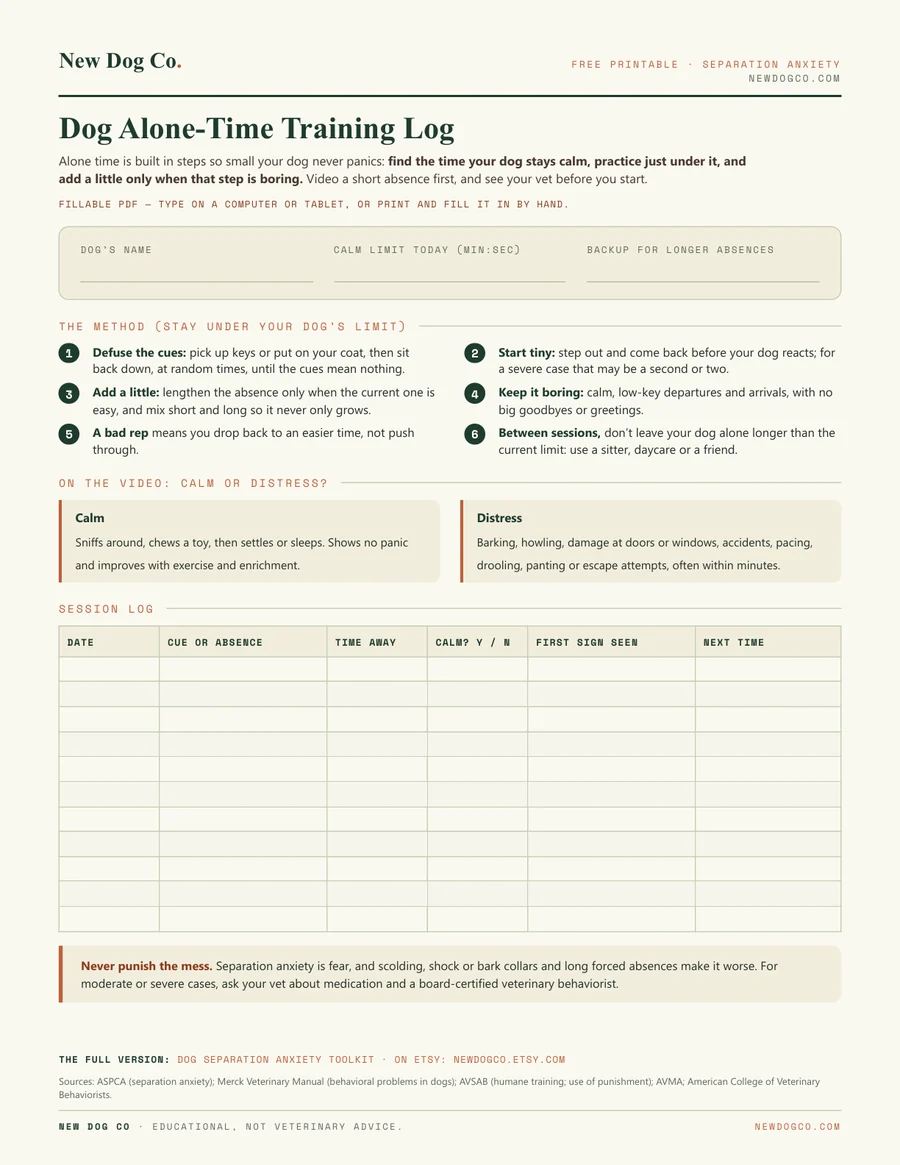
Dog Alone-Time Training Log
How do you teach a dog with separation anxiety to be alone? With absences so short your dog never panics, lengthened a little at a time and only when the current step is easy. That approach, systematic desensitization paired with counterconditioning, is the core of treatment the ASPCA and veterinary behavior literature describe. This one-page log sets out the method, shows how to tell calm from distress on a video of your dog alone, and gives you a session log to track the time away, so you can see real progress and drop back when a session goes badly.
Fillable · bilingual EN/ES · vet-sourced, not a scanned template.
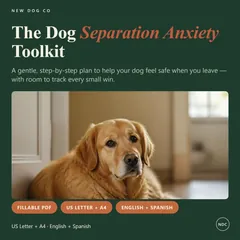 Got the free sheet? The full version → Dog Separation Anxiety Toolkit
What's inside
- The six-step method: defuse the departure cues, start tiny, add a little, keep it boring
- Calm or distress? What to look for on a video of your dog alone
- A fillable session log: date, cue or absence, time away, calm, first sign seen, next time
- Boxes for today’s calm limit and your backup plan for longer absences
- Why punishment and long forced absences make it worse, and when to ask about medication
How to use it
- See your vet first, then video a short real absence to see when, and how, your dog reacts.
- Write the time your dog stays calm in the box, and practice just under it.
- Log every session; add time only after easy ones, and drop back after a bad one.
- Until the limit is long enough, cover longer absences with a sitter, daycare or a friend.
Sources
Vet-sourced: the facts on this sheet come from these sources. It is educational, not veterinary advice.
- ASPCA (separation anxiety)
- Merck Veterinary Manual (behavioral problems in dogs)
- AVSAB (humane training; use of punishment)
- AVMA
- American College of Veterinary Behaviorists
Published
New printables + calm, sourced dog-care tips
Join the Pack and the 25-printable bundle is your instant thank-you — then we email new printables and short, vet-sourced tips as they’re ready. A few times a month, no spam.
The 25-printable pack lands instantly — new printables and tips follow. Unsubscribe anytime. Privacy Policy.Frequently asked questions
- Is it separation anxiety or boredom?
- Video your dog during a short, real absence and watch the timing. Distress that starts within minutes and centers on the doors or windows, with barking, drooling, panting or escape attempts, points to separation anxiety. A dog who noses around, chews something and then settles is more likely bored, and more exercise and enrichment usually help a lot.
- How long does separation anxiety training take?
- Weeks to months, not days, and progress is rarely a straight line. Setbacks are part of recovery. What matters most is consistency and staying below your dog’s limit in every session and between them.
- Should I crate a dog with separation anxiety?
- Not to contain the panic. Shutting a panicking dog in a crate adds to the fear, and frantic dogs can hurt themselves trying to escape. A crate only helps a dog who already relaxes in it.
- Would a second dog help?
- Sometimes. Some dogs are only upset at being alone and stay calm with any company, person or dog. True separation anxiety is usually tied to a specific person, so another dog may not solve it. A video and your vet can help you tell which one you have.
- Is medication a failure?
- No. For moderate to severe cases it is standard care, because it can lower anxiety enough for your dog to learn. Only a veterinarian can choose, dose and monitor it, and it works best alongside the training plan, not instead of it.
Free educational printable. Not veterinary advice, and not a substitute for your vet's official records or an emergency call. Full disclaimer → · Leer en español →