How to Counter-Condition a Reactive Dog (Step by Step)
The core reactivity protocol, spelled out — find the distance, pair the trigger with chicken, and build up without ever going over threshold.
On this page
- What are counter-conditioning and desensitization?
- Step 1: Find your dog’s threshold distance
- Step 2: The core rep — trigger appears, chicken appears
- Step 3: Add “Look at That” (LAT)
- Step 4: Raise the difficulty (close the distance) safely
- What if it stops working or my dog goes over threshold?
- When should I get a professional?
Counter-conditioning means changing what a trigger predicts: every time your dog sees the scary thing, something wonderful appears, so over many reps his brain rewrites “other dog = danger” into “other dog = chicken.” You pair it with desensitization — working at a distance low enough that your dog stays calm (under threshold) — and build up only as fast as he stays relaxed. In practice: find your dog’s threshold distance, mark and feed the instant the trigger appears, keep sessions short and successful, and never let him tip over threshold. That’s the whole engine.
The steps below are the concrete version of the method in our complete guide to reactive dogs. None of it uses corrections — punishment poisons the very association you’re trying to build.
What are counter-conditioning and desensitization?
Two techniques that work as a pair. Desensitization is controlling intensity — usually distance — so the trigger stays below the level that sets your dog off. Counter-conditioning is changing the emotion — pairing that below-threshold trigger with high-value food until the dog feels good, not threatened.
Run alone, neither is enough: flooding a dog with the trigger up close (desensitization done wrong) just terrifies him, and treats handed out over threshold don’t stick because a panicking brain can’t learn. Together, under threshold, they rewire the feeling. AVSAB endorses exactly this reward-based approach over aversive methods.
Step 1: Find your dog’s threshold distance
Everything depends on this. Your dog’s threshold is the distance at which he can see the trigger but still take a treat, respond to his name, and stay loose — aware, but coping.
Set up where you can control the trigger’s distance (a quiet park edge, a parking lot, a friend with a calm “decoy” dog far off). Watch your dog as the trigger appears at a distance, and find the point where he notices it but can still eat and think. That’s your starting line — often much farther than owners expect, sometimes across a street or a field. If he won’t take food or locks on and can’t look away, you’re too close: back up until he can. Knowing the early signs — a hard stare, a freeze, a closed mouth — is the make-or-break skill, so it’s worth learning to read your dog’s body language first.
Step 2: The core rep — trigger appears, chicken appears
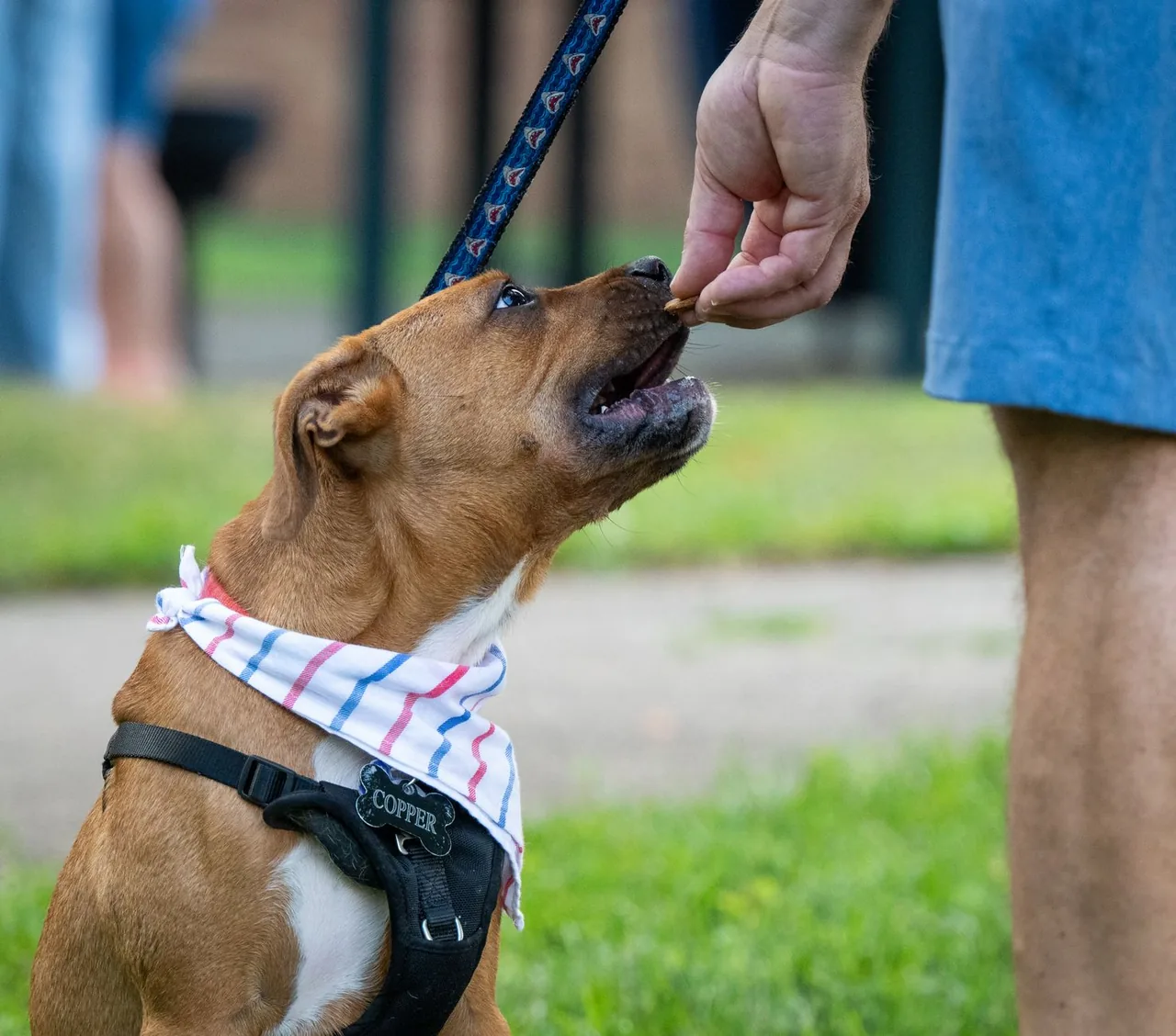
This is the whole exercise, repeated. At your threshold distance: the moment the trigger comes into view, start feeding a steady stream of small, high-value treats (real chicken, cheese, hot dog — not kibble). Keep feeding while the trigger is visible. The instant the trigger passes out of view, stop the treats.
The timing is everything: trigger first, then food, so the trigger reliably predicts the food. If you feed before the trigger appears, or keep feeding after it’s gone, you blur the message. Over dozens of reps, your dog starts to turn to you happily when a trigger appears — the emotional flip you’re after. Keep sessions short (a handful of reps), quit while you’re winning, and end before your dog is tired or stressed.
Step 3: Add “Look at That” (LAT)
Once your dog reliably looks-then-turns-to-you, give the pattern a name. “Look at That,” from Leslie McDevitt’s Control Unleashed, makes the trigger itself a cue: your dog glances at the trigger, you mark (“yes!”), he turns back to you, and he gets the treat. Looking calmly at the scary thing becomes a little game with a happy answer, and it hands your dog a job to do instead of a meltdown to have.
A close cousin, engage-disengage, rewards the look first and then the choice to disengage. Grisha Stewart’s BAT (Behavior Adjustment Training) adds another reward your dog values — distance itself — letting him gather information and then calmly move away. You don’t need all of them; LAT plus a happy U-turn covers most dogs.
Step 4: Raise the difficulty (close the distance) safely
Only when your dog is relaxed and offering the look-back reliably do you make it slightly harder — usually a step closer, or a slightly busier trigger. Change one variable at a time, in small increments, and drop back the moment he tenses.
Think of it as a ladder: each rung is a distance your dog is comfortable at before you climb to the next. If you rush and he goes over threshold, you haven’t just wasted the rep — you’ve practiced the meltdown, which sets you back. Slow is fast here. A written plan and a tracker help you keep the increments honest rather than getting greedy on a good day.
What if it stops working or my dog goes over threshold?
First, add distance — immediately. If your dog is barking and lunging, he’s over threshold and can’t learn; get out of range with a cheerful U-turn and scatter a few treats to reset. Don’t try to train through a meltdown.
If progress stalls, the usual culprits are: you’re working too close, your treats aren’t valuable enough, sessions are too long, or trigger stacking is quietly filling your dog’s stress bucket on tough days. Back up to an easier distance, raise the food value, shorten the sessions, and protect your dog from over-threshold rehearsals the rest of the day. Plateaus are almost always a “too much, too soon” signal, not a sign the method is failing.
When should I get a professional?
See your veterinarian first if the reactivity is sudden or worsening — a medical cause can block all of this. This is educational content, not veterinary advice.
Counter-conditioning is very doable at home, but bring in a credentialed, reward-based professional — a certified trainer (CCPDT), a behavior consultant (IAABC), or a veterinary behaviorist (DACVB) — if you can’t find a workable threshold distance (every walk goes over), if there’s any bite risk, or if you’ve stalled for weeks. A pro can set up controlled “decoy” sessions, coach your timing, and — for severe cases, via your vet — discuss whether medication would help the training land.
Counter-conditioning is simple to describe and takes real patience to do — which is exactly why a structured plan helps. Our Reactive Dog Toolkit turns the steps above into a counterconditioning ladder with session plans and a tracker, all force-free. Pair it with the Dog Body Language Chart Pack so you always know when your dog is under threshold. Trigger first, chicken second, and never over threshold.
Frequently asked questions
- What treats should I use for counter-conditioning?
- The best food your dog will work for — real chicken, cheese, hot dog, or freeze-dried meat, cut tiny so you can deliver many fast. Kibble rarely cuts it near a trigger, because the food has to be exciting enough to compete with the scary thing. Save these high-value treats for reactivity work so they stay special.
- How is counter-conditioning different from just distracting my dog?
- Distraction gets the dog to *ignore* the trigger for a moment; counter-conditioning changes how he *feels* about it. The order is the giveaway: in counter-conditioning the trigger comes first and predicts the food, so the trigger itself becomes good news. Distraction (food first, to pull attention away) doesn't rewire the emotion and tends to fall apart when the trigger is close.
- How many reps or sessions until I see change?
- Expect small shifts within a few weeks of consistent, under-threshold reps — a glance back, a softer body, eating a little closer. Big, walk-changing change takes months. Frequency and staying under threshold matter far more than any single long session; little and often wins.
- Can I do counter-conditioning on a normal walk?
- Partly. Real walks are unpredictable, so treat them as management (keep distance, U-turn away, feed to get past triggers) rather than training. Do your actual counter-conditioning in *set-up* sessions where you control the trigger's distance. As your dog improves, the two blend — but early on, don't rely on chaotic walks to do the teaching.
Educational content only — not veterinary or professional behavior advice. Consult your vet, or a certified trainer or behaviorist, for your pet. Read the full disclaimer →