Why Is My Dog Reactive to Some Dogs but Not Others?
It's not random — it's trigger features, context, and how stressed he already was that day.
On this page
It’s almost never random. The reaction depends on the trigger and the context — the other dog’s size and energy, a head-on approach, a past bad run-in with a similar-looking dog, on leash versus off, and how stressed your dog already was that day. Reactivity is threshold-based, so the dog who ignored a Lab this morning can blow up at one this afternoon — the day’s small stressors stacked up and pushed him over.
It feels personal and unpredictable, but reactivity runs on a fairly readable logic: specific triggers, plus whatever stress your dog is already carrying that day. He isn’t being inconsistent — he’s responding to variables you haven’t clocked yet. Name them and most of the “randomness” disappears. (Our complete guide to reactive dogs covers thresholds and trigger stacking in depth.)
So is it random?
No — and that’s good news, because a pattern is something you can work with. Your dog isn’t reacting to “dogs”; he’s reacting to particular dogs in particular situations. The job is to find the common threads.
Once you can predict which encounters are hard, you can set him up to win — more distance for the tough ones, easy passes for the rest. Unpredictable becomes manageable.
What sets some dogs off and not others?
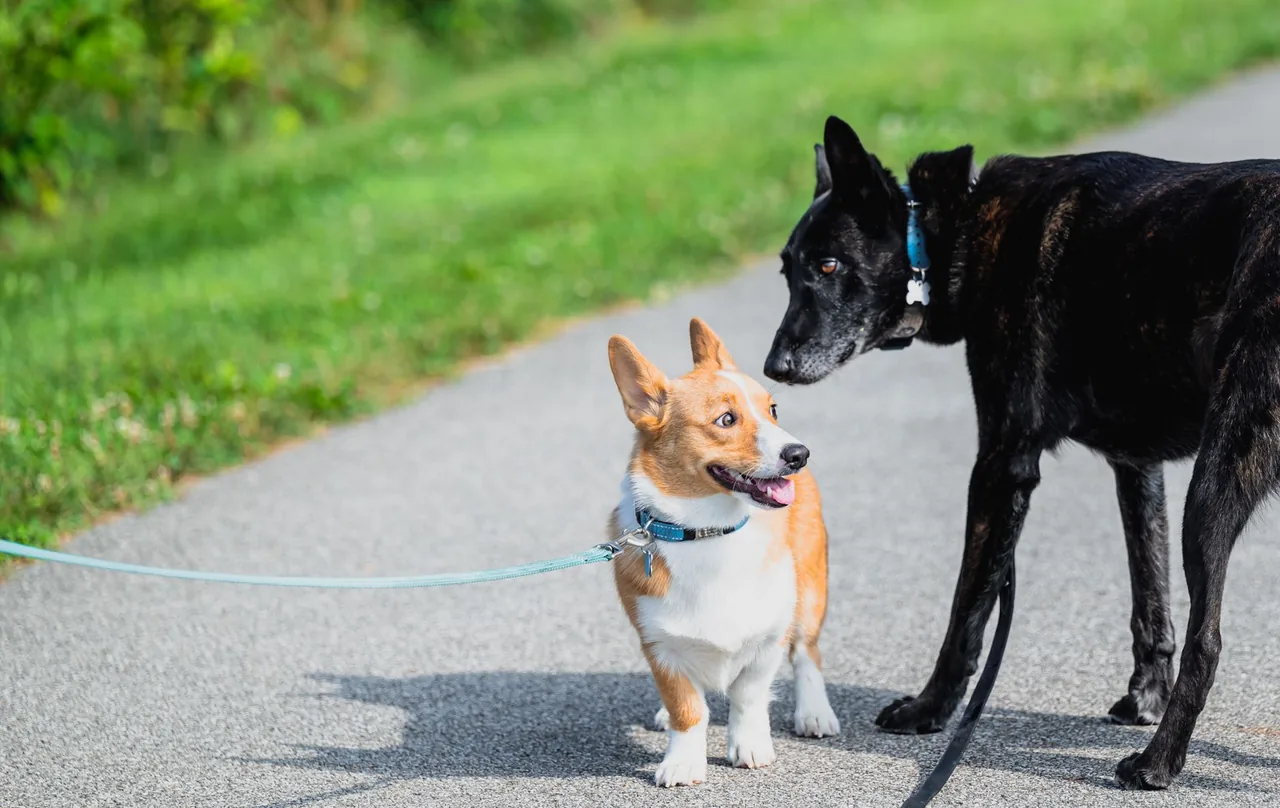
Specific features, mostly. Common ones: a head-on, staring approach; a big or looming dog; fast, erratic, or “rude” young dogs; intact males (different scent and posture); and certain breeds or silhouettes — sometimes a look-alike of a dog from a past scary encounter.
A single bad experience can generalize. If a fluffy black dog once charged him, fluffy black dogs may all read as “danger” for a while. It’s learned, which also means it can be un-learned with careful work.
Energy and manners matter too. A calm dog walking parallel is easy; a bouncy adolescent rushing in face-first is a lot to handle — even for a dog who likes other dogs.
Why on leash and not off leash?
Because the leash takes away his exit. Off leash he can arc around, sniff, and add distance — so he rarely needs to make a scene. Clip on the leash and that escape disappears, and the fear or frustration comes out as barking and lunging instead.
It’s the single biggest context switch in reactivity, and it has its own full explanation in why a dog can be reactive on leash but calm off it.
What is “trigger stacking”?
Stressors add up. Each one — a vet visit that morning, a garbage truck, a skipped breakfast, a hot day, a startling skateboard — nudges your dog’s stress higher and his threshold lower.
So the “last straw” dog gets the blow-up that wasn’t really about him. On a calm day your dog passes that same dog fine; on a stacked day, he’s already near his limit and a small thing tips him over. Same dog, same trigger, different result.
This is why reactivity feels inconsistent. It isn’t — you’re just not seeing all the stressors that stacked up before the one you noticed.
Does a bad day really change the threshold?
Yes, and the effect lingers. After a big stress event, stress hormones can take a couple of days to clear, so a dog can stay touchier than usual well after the thing that rattled him.
That’s why “decompression” days matter — quiet time, sniffy walks, easy wins — to let the tank drain. Pushing a stressed dog into more triggers just keeps the level high and the fuse short.
How do I find my dog’s pattern?
Keep a simple log for a couple of weeks. For each encounter jot: what kind of dog (size, energy, breed-ish), the distance, on leash or off, the time of day, anything stressful earlier, and how your dog reacted (ignored / looked / barked / lunged).
The threads jump out fast. Maybe it’s “big dogs head-on, under 15 feet, on leash, after a busy morning.” That sentence is the start of your plan — it tells you exactly what to manage and what to practice.
How do I actually work on it?
Once you know the pattern, the method is the same calm, under-threshold work that helps any reactive dog: at a distance where he notices the trigger but can still eat and listen, you feed the moment it appears — so over many reps the other dog comes to mean good things are on the way, not trouble. The full breakdown lives in our guide to helping a leash-reactive dog.
Manage alongside the training: avoid the hardest triggers while you build skills, give distance on stacked days, and protect recovery time. You’re lowering the difficulty so your dog can actually succeed.
Does my own tension make it worse?
Often, yes — and it’s nobody’s fault. After a few bad encounters, you start scanning the street for dogs, and the moment you spot one your shoulders tense and the leash goes tight. Your dog feels all of that travel down the line. A tightened leash plus your held breath becomes its own little signal that something worrying is coming — so he’s already half over threshold before the other dog is even close.
You can’t fake being relaxed, but you can change the mechanics. Keep the leash loose, breathe out, and keep moving — an early, cheerful U-turn beats freezing and bracing every time. Narrate it lightly if it helps (“let’s go this way”). The more your own body says “no big deal,” the more your dog can borrow that calm from you.
When should I see a vet or a behaviorist?
See your vet first, especially for a sudden change — pain is one of the most-missed reasons a dog gets touchier, and a medical workup rules it out. This article is educational, not a substitute for professional care.
For a real or worsening case — particularly any bite or near-bite — bring in a credentialed, reward-based professional: a certified trainer (CCPDT), a behavior consultant (IAABC), or a veterinary behaviorist (DACVB).
Reactivity that looks random almost never is — it’s a pattern of triggers, context, and stacked-up stress, and naming the pattern is the first real step. If you want the whole plan in one place — a trigger log to find your dog’s pattern, the threshold work, the counter-conditioning, and the gear — our Reactive Dog Toolkit is the step-by-step system to start working on it today.
Frequently asked questions
- Is my dog being dominant, or does he hate other dogs?
- No. It's fear or frustration about specific triggers, not dominance or hatred — most reactive dogs are perfectly happy with their known dog friends. The "dominance" framing leads to punishment, which makes fear-based reactivity worse.
- Why is he worse with small dogs (or big dogs, or puppies)?
- Usually a feature he finds threatening or over-arousing — a big head-on dog, an erratic puppy, or a look-alike of a past scare. It's the feature and the context, not that particular individual.
- Can one bad encounter really cause this?
- Yes. A single frightening event can generalize to similar-looking dogs. Because it's learned, it can also be reshaped with patient, under-threshold practice.
- Will neutering or spaying fix it?
- Not reliably — reactivity is mostly learned and emotional, not hormonal, so don't expect surgery to "cure" it. Ask your vet about the decision on its own merits.
Educational content only — not veterinary or professional behavior advice. Consult your vet, or a certified trainer or behaviorist, for your pet. Read the full disclaimer →