Why Is My Rescue Dog Scared of Everything?
Fear vs. shutdown, the stress signals to read, and how to build trust without flooding a frightened dog.
On this page
Most rescue dogs who seem scared of everything aren’t broken — they’re under-socialized, carrying a rough history, or simply overwhelmed by a world that’s all new at once. A dog who missed the critical socialization window as a puppy, or spent months in a shelter, never learned that everyday things (footsteps, hats, the vacuum, strangers) are safe. The fear is a learned survival response, not a personality flaw — and with patience and the right approach, it almost always gets better.
The key is understanding what the fear looks like, and resisting the urge to “get him used to it” by force.
Why is my rescue dog so fearful?
Because fear is what kept him safe before you. Many rescues missed early, positive exposure to the ordinary world during the sensitive puppy period (roughly 3–14 weeks), so the brain files anything unfamiliar under “possible threat.” Others learned specific fears the hard way.
You usually can’t know the exact history, and you don’t need to. What matters is that the fear is real to your dog and reversible with a careful, reward-based plan.
It also tends to surface rather than appear — a dog who was shut down and quiet in week one may show more fear as he decompresses and starts to feel enough to react. That’s not regression; it’s the real dog arriving. Our guide on how long a rescue dog takes to adjust explains that arc.
Is my dog scared, or shut down?
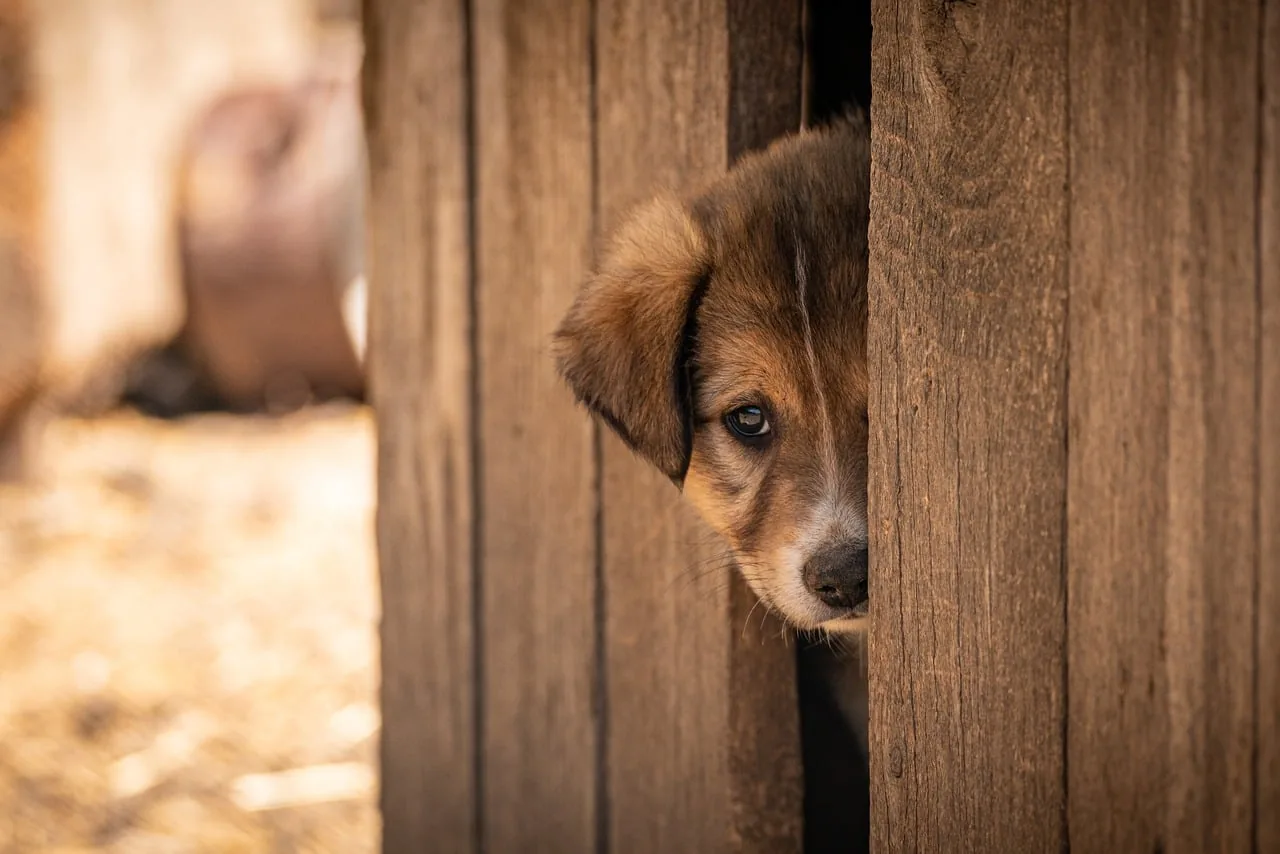
This is the most important distinction to get right, because they look opposite but come from the same place. A visibly scared dog reacts — backing away, barking, trembling, trying to flee. A shut-down dog goes still and silent: frozen, flat, not eating, not moving, tolerating handling without protest.
People often read a shut-down dog as “calm” or “so well-behaved.” He isn’t calm — he’s overwhelmed past the point of reacting, the canine version of freezing. It’s a sign of deep stress, not comfort.
Both need the same thing: less pressure, more space, and the freedom to choose. A shut-down dog especially should never be dragged out, cornered, or “socialized” through force — let him come to you.
How do I read my dog’s stress signals?
Dogs tell you they’re scared long before a growl — most people just miss the early signals. Learn the quiet ones and you can give space before fear ever escalates.
Watch for lip-licking when there’s no food, yawning when he’s not tired, a tucked tail, ears pinned back, a lowered body, and “whale eye” (a white crescent showing at the corner of the eye). Turning away, freezing, or refusing treats he’d normally take are all “I need more room” signals.
A growl is not disobedience — it’s information, and one of the last warnings before a snap. Never punish it; punishing a growl just teaches a dog to skip the warning next time. Our dog body language guide breaks down the whole ladder, and it’s the single most useful skill for living with a fearful dog.
How do I help a scared rescue dog build confidence?
Slowly, and always at the dog’s pace. The goal is to change how he feels about scary things, not to force him to endure them.
The wrong approach is flooding — overwhelming a dog with the thing he fears to prove it’s harmless (dragging him into a crowd, holding him while strangers reach in). Flooding usually makes fear worse and can shatter trust. AVSAB is clear that fear-based, force-based methods raise anxiety and aggression.
The right approach is the opposite: control the distance, keep every exposure short and positive, and pair the scary thing with something wonderful (great treats, calm praise) at a range where your dog still feels safe. Let him approach — never push. Confidence is built one small, successful, rewarded step at a time. As the trainer Patricia McConnell puts it, you’re teaching the dog that you make good things happen and the world is predictable.
Give it a steady routine, a safe den, and time. A predictable home is the foundation the whole thing rests on.
When should I get professional help?
For a genuinely fearful dog, sooner is better than later — and it’s a sign of good ownership, not failure. This is educational content, not a substitute for veterinary care.
See your vet first, especially if the fear appeared suddenly or the dog also seems unwell — pain and medical issues can drive fear and irritability, and for moderate-to-severe anxiety a vet can discuss whether medication would help the training work. Then bring in a credentialed, reward-based professional: a certified trainer (CCPDT), a behavior consultant (IAABC), or a veterinary behaviorist (DACVB), ideally one experienced with fearful dogs. Get help promptly for any fear that involves growling, snapping, or a bite.
The most useful thing you can do for a fearful dog is learn to read him — to catch the lip-lick and the whale eye before the fear ever boils over. Our Dog Body Language Chart Pack is a vet-sourced visual guide to exactly those signals. And because a fearful dog heals fastest in a calm, predictable home, the New Dog Owner Starter Kit covers the week-one routine that gives him something steady to stand on. Go at his pace. Trust is built, never rushed.
Frequently asked questions
- Will my scared rescue dog ever get better?
- Almost always, yes — with patience and a reward-based approach. Some deeply rooted fears are managed rather than fully cured, but improvement is the norm. The earlier and more consistently you start, the further a fearful dog can come.
- Should I comfort my dog when he's scared, or does that reinforce fear?
- You can comfort him — you cannot reinforce an emotion like fear with kindness. Calm reassurance and letting him retreat to a safe spot are exactly right. What you want to avoid is *forcing* him toward the scary thing, not soothing him.
- Why is my rescue dog only scared of men (or hats, brooms, etc.)?
- Specific fears usually trace back to missed socialization or a bad past association. The fix is the same: distance plus good things, letting the dog choose to approach, never forcing contact. A person the dog fears can help by ignoring him and tossing treats away from themselves.
- Is a scared dog a dangerous dog?
- Not usually — most fearful dogs want distance, not conflict, and will choose to flee if they can. But fear is the most common driver of bites when a dog feels cornered, which is exactly why you read the early signals, give space, and never punish a warning.
Educational content only — not veterinary or professional behavior advice. Consult your vet, or a certified trainer or behaviorist, for your pet. Read the full disclaimer →