Dog Recall Training Log
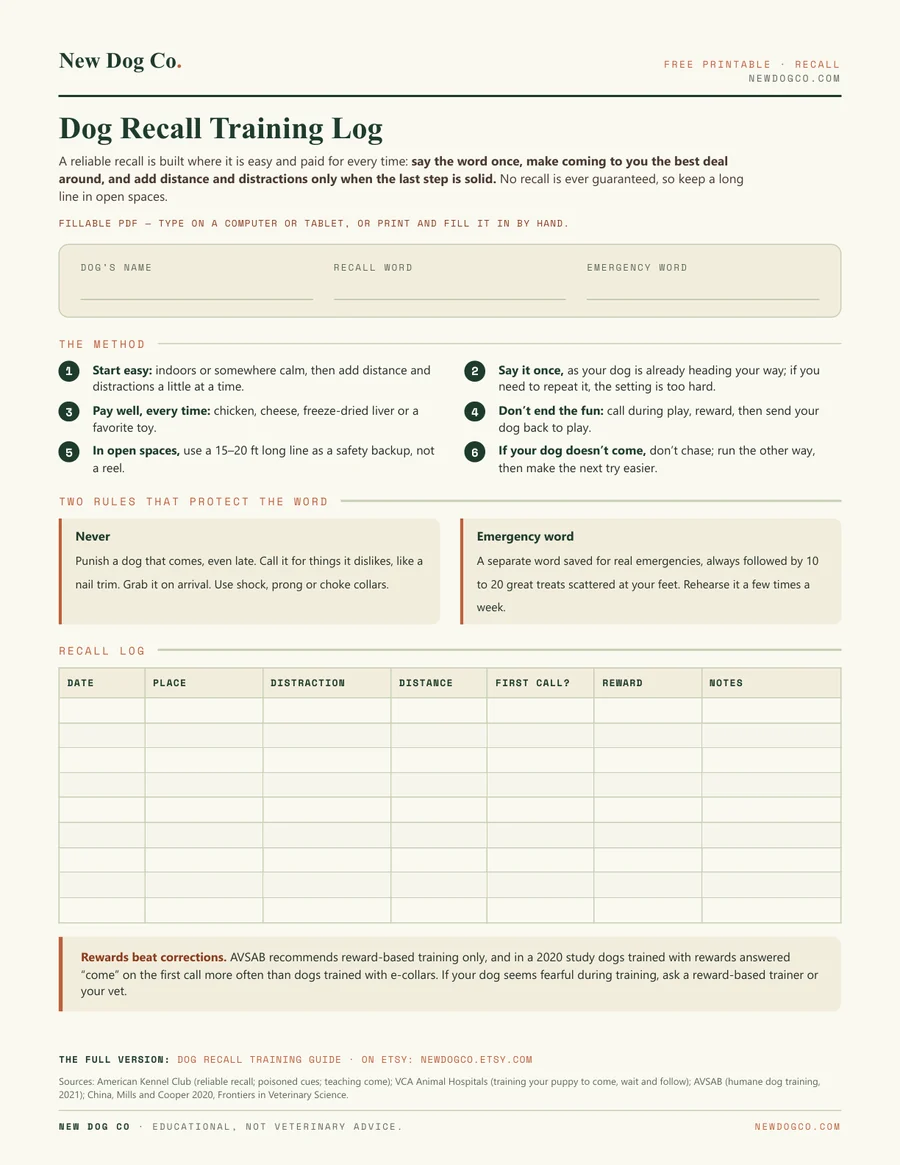
How do you teach a dog to come when called? Start where it is easy, say the word once as your dog is already heading your way, pay every recall with something great, and add distance and distractions only when the last step is solid. That is the reward-based method the AKC describes and the AVSAB recommends. This one-page log lays out the six steps, the two rules that keep the word worth answering, an emergency recall, and a log for place, distraction, distance and whether your dog came on the first call.
Fillable · bilingual EN/ES · vet-sourced, not a scanned template.
 Got the free sheet? The full version → Dog Recall Training Guide
What's inside
- The six-step method, from easy indoor recalls to a long line in open spaces
- What never to do with the recall word, so it keeps its meaning
- How to set up a separate emergency recall word
- A fillable recall log: date, place, distraction, distance, first call, reward, notes
- Why rewards beat corrections, from the AVSAB and a 2020 study
How to use it
- Write in your recall word and a separate emergency word, and tell everyone in the house.
- Practice in easy places first and log each session, including the misses.
- Move to a harder place, distraction or distance only after several first-call successes in a row.
- If your dog stops coming on the first call, go back to the last easy setting for a while.
Sources
Vet-sourced: the facts on this sheet come from these sources. It is educational, not veterinary advice.
- American Kennel Club (reliable recall; poisoned cues; teaching come)
- VCA Animal Hospitals (training your puppy to come, wait and follow)
- AVSAB (humane dog training, 2021)
- China, Mills and Cooper 2020, Frontiers in Veterinary Science
Published
New printables + calm, sourced dog-care tips
Join the Pack and the 25-printable bundle is your instant thank-you — then we email new printables and short, vet-sourced tips as they’re ready. A few times a month, no spam.
The 25-printable pack lands instantly — new printables and tips follow. Unsubscribe anytime. Privacy Policy.Frequently asked questions
- How do I teach my dog to come when called?
- Start indoors or somewhere calm, and say the word once as your dog is already heading toward you. Pay every recall with something your dog loves, like chicken, cheese or a favorite toy, then add distance and distractions a little at a time. The AKC also suggests calling during play, rewarding, and sending your dog back to play, so “come” never means the fun is over.
- Why does my dog ignore “come”?
- The word may have lost its meaning. The AKC calls this a poisoned cue: it happens when the word is introduced too early, repeated, rewarded inconsistently, or used for things the dog dislikes, like a nail trim or leaving the park. The fix is to retrain from scratch, often with a new word such as “here.”
- What should I do if my dog doesn’t come?
- Don’t chase, because that turns it into a game of keep-away. The AKC suggests running the other way so your dog follows, then making the next try easier. And never punish a dog that comes, even if it took its time.
- What is an emergency recall?
- A separate word saved for real emergencies. VCA suggests following it with 10 to 20 high-value treats scattered at your feet and rehearsing it a few times a week. If you need it more than once every few months, your everyday recall needs more work.
- Do I need an e-collar to train a recall?
- No. The AVSAB recommends reward-based training only, and in a 2020 study of dogs with off-leash problems, the dogs trained with rewards answered “come” on the first call more often, and faster, than the dogs trained with e-collars.
- How long should a long line be?
- The AKC suggests a 15 to 20 foot line in parks and other open spaces. VCA reminds you it is a safety backup, not a reel: pulling a dog in only makes it lean back.
Free educational printable. Not veterinary advice, and not a substitute for your vet's official records or an emergency call. Full disclaimer → · Leer en español →